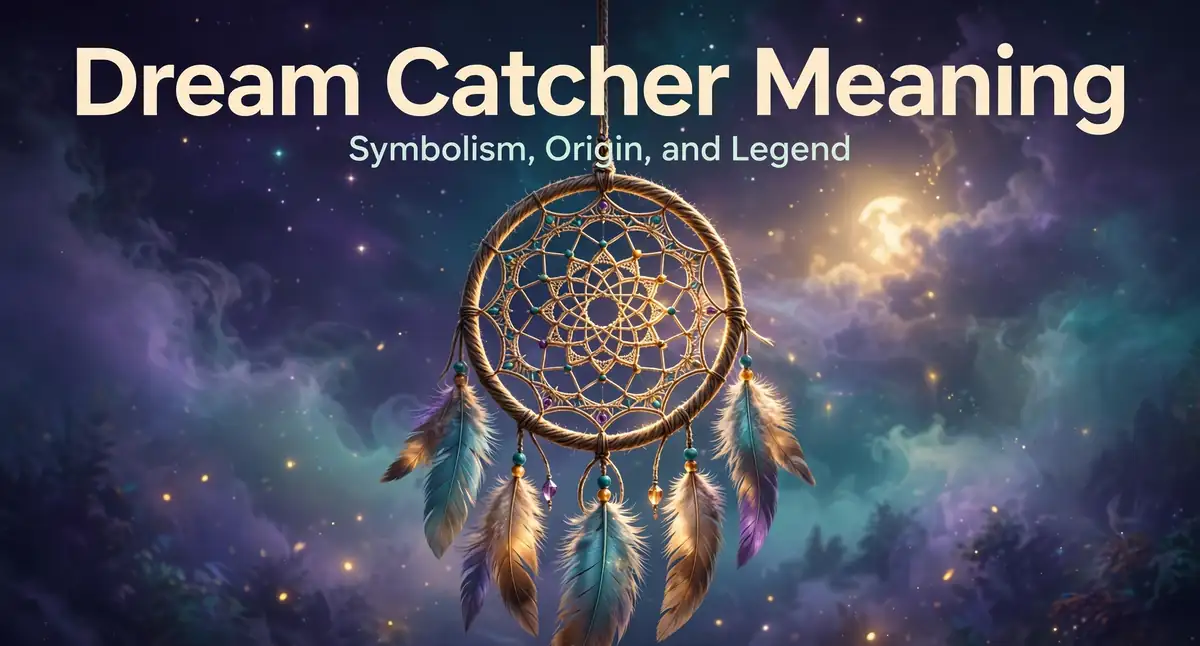
A dream catcher is a handmade hoop with a woven web, traditionally hung above a bed or cradle to filter dreams. According to Ojibwe belief, the web catches bad dreams while good dreams slip through and slide down the feathers to the sleeper. Today it is also a popular symbol of protection and Native heritage.
Key Takeaways
- A dream catcher is a protective charm from Ojibwe (Anishinaabe) culture, not a generic decoration.
- The web is believed to trap nightmares, which fade at morning light, while good dreams pass through.
- Its story comes from the legend of Asibikaashi, the Spider Woman who protected children.
- Each part has meaning: the hoop is the circle of life, the web filters dreams, feathers carry good dreams down.
- Mass-produced versions raise cultural appropriation concerns; buying from Native artists shows respect.
What Does Dream Catcher Mean?
The dream catcher meaning centers on protection during sleep. In its original Ojibwe context, it is a sacred charm hung over an infant’s cradle. The woven web acts like a spider’s web, catching anything harmful floating in the night air, including frightening dreams.
The most common explanation says bad dreams get tangled in the web and disappear when the first morning light touches them. Good dreams, being light and gentle, pass through the center hole and travel down the feathers to reach the sleeping person below.
Over time, the meaning has broadened. Many people now hang dream catchers as symbols of safety, positive energy, and connection to Native culture. For some, it is a spiritual object. For others, it is a beautiful reminder to let go of bad thoughts and welcome good ones.
It is worth noting that the original purpose was protective rather than dream-related in the modern sense. Early accounts describe the charms as catching “any harm that might be in the air,” with the dream-filtering story developing as the tradition evolved.
The Origin and Legend of the Dream Catcher
Dream catchers come from the Ojibwe people, also called the Anishinaabe, of the Great Lakes region. In the Ojibwe language, the dream catcher is called asabikeshiinh, which is the inanimate form of the word for spider.
The tradition begins with Asibikaashi, the Spider Woman. According to legend recorded by ethnographer Frances Densmore in 1929, Asibikaashi cared for all the children and people of the land. As the Ojibwe Nation spread across North America, she could no longer reach every child each night.
To solve this, mothers and grandmothers began weaving webs in her honor. They bent willow branches into hoops and wove sinew or plant fiber across them to mimic a spider’s web. Hung on a cradle hoop, these small charms carried Asibikaashi’s protection to each child.
The tradition stayed within Ojibwe communities for generations. It spread to other Native nations, including the Lakota, largely through the Pan-Indian Movement of the 1960s and 1970s. By the 1980s, dream catchers had become widely marketed as “Native crafts items,” and by the 1990s they were among the most popular and marketable symbols of Native culture worldwide.
What Each Part of a Dream Catcher Symbolizes
Every element of a traditional dream catcher carries meaning. Understanding the parts deepens the dream catcher meaning beyond decoration.
- The hoop: Usually bent willow, the circle represents the circle of life, the sun and moon’s path, and the idea that all things are connected.
- The web: Woven like a spider’s web, it filters what reaches the sleeper. Bad dreams tangle in its threads while good dreams find the center.
- The center hole: The opening in the middle is the passage for good dreams and positive visions to travel through.
- The feathers: Hung below the hoop, feathers are soft ladders that carry good dreams gently down to the sleeper. Owl feathers traditionally stood for wisdom, eagle feathers for courage.
- The beads: A single bead in the web often represents the spider itself, the weaver of protection. Multiple beads can stand for trapped bad dreams.
- The number of points: Some webs are woven with 8 points for the spider’s eight legs, or 13 points for the 13 phases of the moon.
Traditional materials matter too. Willow, sinew, natural feathers, and wooden beads connect the object to the earth. Many Native teachers emphasize that plastic and synthetic versions lose this connection.
How Dream Catchers Are Used Today
Traditionally, dream catchers hang above a cradle or bed, close enough to watch over the sleeper. Ojibwe families made them small, just a few inches wide, sized for an infant’s cradle.
Modern uses vary widely:
- Above beds: Many people hang them over beds hoping for peaceful sleep and fewer nightmares.
- In cars: Small dream catchers dangle from rearview mirrors as traveling protection.
- As gifts: They are given to new parents, graduates, and anyone starting something new, carrying wishes of safety.
- As tattoos and jewelry: The design appears in tattoos, earrings, and necklaces as a personal symbol of protection.
- In home decor: Large decorative versions hang in living rooms and on walls, though these are far from the small traditional charms.
How well any of this “works” depends on belief. For those who hold the tradition, the dream catcher’s power is real and spiritual. For others, it works as a calming ritual, a nightly reminder that they are safe, which itself can ease the mind before sleep.
Dream Catcher vs. Other Protective Charms
The dream catcher is sometimes confused with protective objects from other cultures, but each has its own story. The Turkish evil eye (nazar) wards off jealous gazes. The Christian cross or saint medals offer divine protection. Feng shui cures redirect energy in a space.
What sets the dream catcher apart is its specific link to sleep and dreams, plus its spider-web design. No other major tradition uses a woven web as a dream filter. Its meaning is also inseparable from a living culture: the Ojibwe and other Native nations still make and use them traditionally today.
This living connection is why respect matters. Unlike ancient symbols with no continuous tradition, the dream catcher belongs to communities who can tell you exactly what it means to them.
Is It Cultural Appropriation to Own a Dream Catcher?
This question comes up often, and the answer depends on how you approach it. Many Native voices say mass-produced, plastic dream catchers sold as trendy decor disrespect a sacred object. When factories copy the design with no understanding, it reduces a spiritual charm to a fashion accessory.
However, appreciation is different from appropriation. Respectful steps include:
- Learn the real history: Know that it comes from Ojibwe culture and what each part means.
- Buy from Native artists: Purchasing directly from Indigenous makers supports the communities the tradition comes from.
- Avoid sacred misuse: Do not use the design in mocking or disrespectful contexts.
- Teach others: When someone admires yours, share its true origin story.
The core principle is simple. Treat the dream catcher as what it is, a meaningful cultural object, not just a pretty web. Respect turns ownership into appreciation.
Frequently Asked Questions
What is the real meaning of a dream catcher?
A dream catcher is an Ojibwe protective charm meant to filter dreams. Its web traps bad dreams, which fade at sunrise, while good dreams pass through the center and slide down the feathers to the sleeper. Originally it protected infants in their cradles.
Where should you hang a dream catcher?
Traditionally it hangs directly above a cradle or bed, where it can watch over the sleeper. It should be somewhere with exposure to morning light, since legend says daylight destroys the trapped bad dreams. Many people also hang small ones in cars or windows.
Do dream catchers actually work?
There is no scientific proof that dream catchers change dreams. For believers, their power is spiritual and real within Ojibwe tradition. For others, they can still help by creating a calming bedtime ritual. Feeling safe before sleep genuinely improves rest.
What do the colors of a dream catcher mean?
Traditional dream catchers use natural materials without assigned color meanings. Modern colored versions are mostly decorative choices. Some sellers attach meanings, such as blue for peace or red for energy, but these are new inventions, not part of Ojibwe tradition.
Is it disrespectful to have a dream catcher tattoo?
Opinions vary. Some Native people see it as honoring the symbol, others see it as appropriation, especially when the wearer knows nothing of its origin. If you choose one, learn its history first and consider supporting Native artists for the design.
Conclusion
The dream catcher meaning runs deeper than its pretty web suggests. Born from the Ojibwe legend of Asibikaashi the Spider Woman, it began as a small willow charm protecting infants through the night. Its hoop holds the circle of life, its web filters darkness from light, and its feathers deliver gentle dreams to those below.
Today it travels the world, sometimes honored and sometimes misunderstood. Knowing its true story lets you appreciate it properly, if you hang one for protection, give one as a blessing, or simply admire its craft. Like the web itself, the dream catcher’s meaning catches what matters and lets the rest fall away.

I am James Patterson an American writer sharing thoughtful insights on dreams, spirituality, personal growth, and everyday life through practical guides and meaningful stories for SpiritualDreamz.com readers everywhere with warmth.