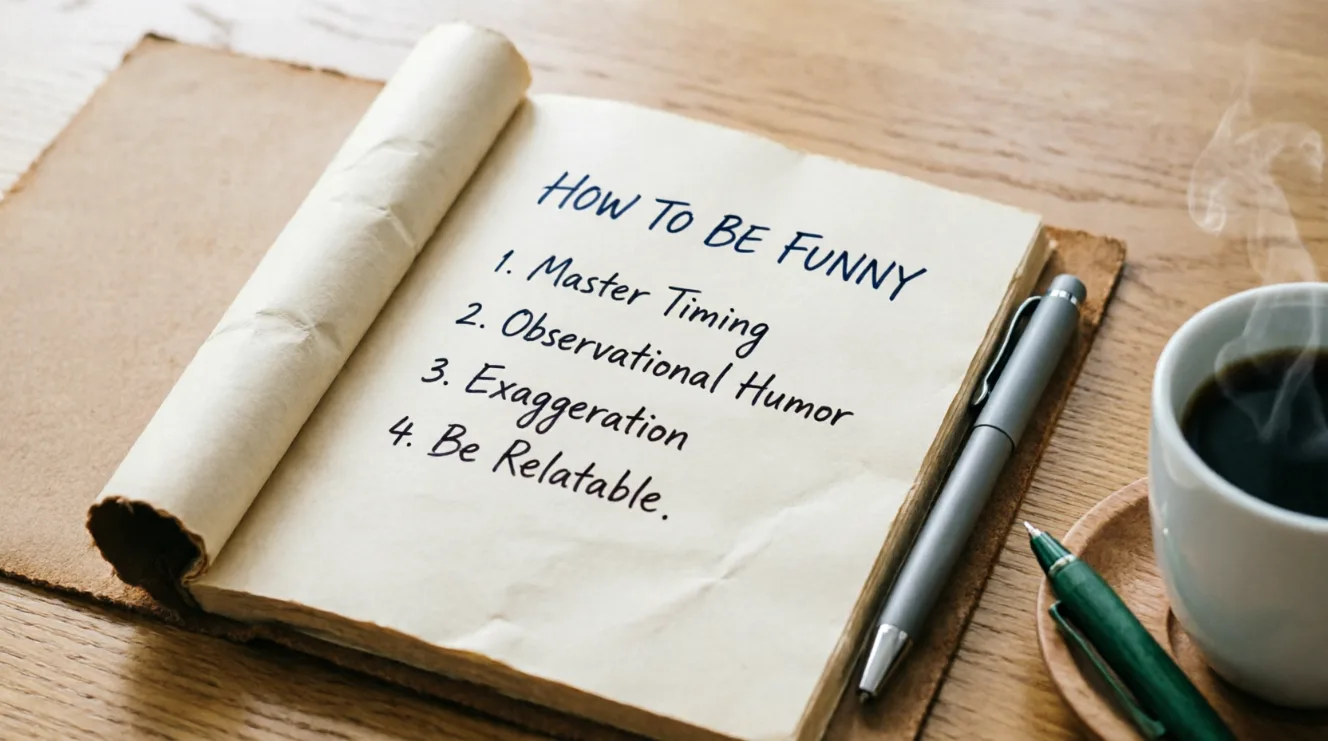
To be funny, focus on noticing everyday situations, finding unexpected angles, using specific details, improving your timing, and telling engaging stories. You do not need to memorize hundreds of jokes. Good humor usually comes from observation, surprise, confidence, and knowing what fits the people and situation around you.
Key Takeaways
- Being funny is a skill you can improve through practice and observation.
- Surprise, specificity, timing, and delivery are more useful than memorizing jokes.
- Funny stories often work better in everyday conversation than forced punchlines.
- Reading the room helps you know when humor is appropriate.
- The goal is not to make everyone laugh; it is to make conversations more enjoyable.
Can Anyone Learn How to Be Funny?
Yes. You may not become a professional comedian, but you can become noticeably funnier in everyday life.
Humor is not only about having a naturally funny personality. Many practical comedy skills can be developed, including observation, timing, storytelling, word choice, and understanding what an audience expects. Several guides on humor emphasize that people can improve these skills through deliberate practice rather than simply waiting for funny ideas to appear.
The important thing is to stop thinking that being funny means constantly telling jokes.
A funny person might make a clever observation, tell an amusing story, give an unexpected answer, exaggerate a harmless detail, or simply react to something in an unusual way.
Your goal is not to become someone else. It is to become better at finding the humor that already exists in ordinary situations.
10 Practical Ways to Become Funnier
1. Pay Attention to Everyday Details
Funny people often notice things that everyone else overlooks.
Instead of thinking, “My morning was terrible,” notice exactly what happened.
Maybe your alarm went off three times, your coffee spilled on your shirt, and your dog looked at you as if you had personally disappointed him.
Those details are much more interesting than simply saying, “I had a bad morning.”
Start observing people, conversations, habits, technology, work, family life, and your own mistakes. Keep a note on your phone for funny observations. Over time, you will have more material to work with.
2. Use Surprise
One of the basic ingredients of humor is surprise. People expect one thing, and you give them something slightly different.
For example:
Question: “How was your weekend?”
Normal answer: “Pretty good. I relaxed.”
Unexpected answer: “Very productive. I successfully avoided every responsibility I had.”
The second answer creates a small surprise without requiring a complicated joke.
You can experiment with unexpected comparisons, unusual descriptions, or playful exaggeration. Surprise is frequently identified as an important part of effective humor.
3. Get More Specific
Specificity can make an ordinary observation much funnier.
Compare:
“My boss talks too much.”
with:
“My boss starts every meeting by saying, ‘This will only take five minutes,’ which is how I know I have at least an hour left.”
The second version creates a clearer picture.
Specific details give people something they can recognize and visualize. Instead of using broad statements, describe the strange little detail that makes a situation interesting.
4. Learn the Rule of Three
The rule of three is a simple comedic structure: establish a pattern with two expected items, then make the third item surprising.
For example:
“I went to the store for milk, eggs, and emotional stability.”
The first two items create a normal pattern. The third breaks it.
You can use this technique in casual conversation, writing, speeches, and storytelling. The key is not to force every sentence into a joke. Use it occasionally when the situation naturally gives you an opportunity.
5. Improve Your Timing
A good line can become less funny if you deliver it at the wrong moment.
Timing includes knowing when to speak, when to pause, and when to stop.
Suppose someone asks:
“Are you good at cooking?”
You could say:
“I make a fantastic grilled cheese.”
Pause.
“Assuming the fire alarm isn’t part of the recipe.”
The pause gives the listener a moment to form an expectation before you change it.
Good comedic timing does not necessarily mean speaking slowly. It means giving the setup and funny idea enough space to work. Guides on comedy and public speaking regularly highlight timing, pauses, and concise delivery as important parts of humor.
6. Tell Stories Instead of Constantly Telling Jokes
You do not need a collection of perfect one-liners to be funny.
In normal conversations, funny stories are often easier and more natural.
For example, instead of saying:
“I’m terrible at parking.”
Tell the story of the time you spent five minutes trying to fit into a parking space while three people watched.
A story gives you context, characters, details, and a natural ending. If the story is not hilarious, it can still be interesting.
This is why conversational humor is often less about performing and more about sharing amusing experiences.
7. Use Self-Deprecating Humor Carefully
Making fun of yourself can make humor feel more relatable because you are not always putting someone else down.
For example:
“I bought a planner to organize my life. I have successfully scheduled three naps.”
That can work because the joke is harmless and relatable.
However, self-deprecating humor should not mean constantly insulting yourself. You do not need to convince everyone that you are incompetent, unattractive, or unsuccessful.
Keep it playful rather than genuinely negative.
8. Read the Room
This is one of the most important skills in humor.
A joke that works with close friends may be completely inappropriate at work, during a serious conversation, or with someone you barely know.
Before making a joke, consider:
- Who am I talking to?
- What is happening right now?
- Is this person comfortable with this kind of humor?
- Could the joke embarrass someone?
- Is this the right time?
Professional comedian Justin Martindale similarly emphasizes “reading the room” and considering if a particular moment is suitable for humor.
Being funny is not just knowing what could be funny. It is knowing when to say it.
9. Build on What Other People Say
You do not always have to invent something from scratch.
Listen carefully to the conversation and look for something you can play with.
If your friend says:
“I’ve been waiting for my food for 40 minutes.”
You might respond:
“At this point, the restaurant is raising the chicken.”
That response uses the information already available instead of changing the subject to tell a prepared joke.
This also makes your humor feel more natural because it belongs to the conversation.
10. Practice Without Forcing It
Trying desperately to make everyone laugh can make you less funny.
If you say something humorous and immediately stare at everyone waiting for approval, the moment can become uncomfortable.
Instead, make the comment and continue the conversation.
Practice by:
- Writing down funny observations
- Retelling amusing experiences
- Watching comedians and studying their timing
- Trying different ways of delivering the same line
- Noticing which comments naturally get reactions
- Practicing playful responses with trusted friends
The purpose of practice is to develop instincts, not to turn every conversation into a comedy show.
How to Be Funny in Everyday Conversation
If your main goal is to become funnier around friends, coworkers, or new people, start small.
You can use three simple habits:
Notice → Twist → Deliver
First, notice something interesting.
Second, find a slightly unexpected way to describe it.
Third, deliver the observation naturally.
For example, someone arrives at a meeting carrying an enormous coffee.
Notice: They have a huge coffee.
Twist: Compare the size to something unexpected.
Deliver: “That’s not coffee. That’s a personal water tower.”
You do not need to shout or perform. A calm delivery can sometimes make the line funnier.
Also remember that being a good conversationalist is more than making people laugh. Listen, ask questions, show interest, and let other people have their moments. Humor works best when it adds to the interaction instead of taking it over.
What to Do When Your Joke Doesn’t Get a Laugh
It happens to everyone.
Even professional comedians have jokes that do not work. The worst response is usually to panic and explain why your joke was funny.
If nobody laughs, simply move on.
You can say something like:
“Okay, that sounded better in my head.”
Then continue the conversation.
Ironically, acknowledging a failed joke can sometimes create a better laugh than the original joke.
Do not treat every unsuccessful line as evidence that you are not funny. Humor depends on timing, audience, context, and delivery. A line that works brilliantly in one situation may fail completely in another.
Common Mistakes That Make Humor Less Funny
Trying too hard
If every sentence is designed to get a laugh, people may feel like they are watching a performance rather than having a conversation.
Explaining the joke
If people do not understand the joke, explaining every detail usually makes the moment worse. Learn from it and move on.
Making everything about yourself
Being funny does not mean dominating the conversation. Give other people space to contribute.
Insulting people
Humor that humiliates someone can damage relationships even if other people laugh. When possible, choose humor that creates connection rather than embarrassment.
Using humor at the wrong time
A funny comment during a celebration may work. The same comment during a serious or emotional moment may be completely inappropriate.
Copying another person’s personality
You do not need to become the loudest person in the room. Some people are naturally deadpan, some are playful, some are observational, and others are great storytellers.
Find the style that fits your personality.
Frequently Asked Questions
Can anyone learn to be funny?
Most people can improve their ability to use humor. You can practice observation, storytelling, timing, surprise, and delivery. Becoming funnier does not necessarily mean becoming a comedian. It can simply mean learning how to notice amusing situations and communicate them more effectively.
How can I become naturally funny?
Start by paying attention to everyday life instead of trying to invent jokes constantly. Notice unusual details, listen closely to conversations, experiment with unexpected observations, and practice telling short stories. With repetition, these habits can become more natural.
How do I improve my sense of humor?
Expose yourself to different types of comedy and pay attention to why something makes you laugh. Study timing, word choice, surprise, characters, exaggeration, and storytelling. Then experiment with those techniques in low-pressure conversations.
How can I be funny without trying too hard?
Do not make getting a laugh your only goal. Listen to the conversation, respond to what is actually happening, and use humor when it naturally fits. A short, well-timed observation is often better than forcing a long joke.
How do I make people laugh in conversation?
Listen for opportunities. Use unexpected answers, specific observations, playful exaggeration, callbacks to something previously mentioned, and short personal stories. Most importantly, pay attention to how the other person responds and adjust your humor to the situation.
Conclusion
Learning how to be funny is less about becoming a completely different person and more about developing better habits.
Notice the little things. Find unexpected angles. Be specific. Tell better stories. Improve your timing. Listen to people. Read the room. And do not be afraid of a joke that falls flat.
The best everyday humor usually feels natural rather than rehearsed. You do not need to make everyone laugh. If your conversations become more relaxed, playful, and enjoyable, you are already getting funnier.

I am Stephen King an American writer exploring spirituality, dreams, mindfulness, and personal growth. Through SpiritualDreamz.com, he shares thoughtful insights to inspire reflection, clarity, and meaningful everyday living.










