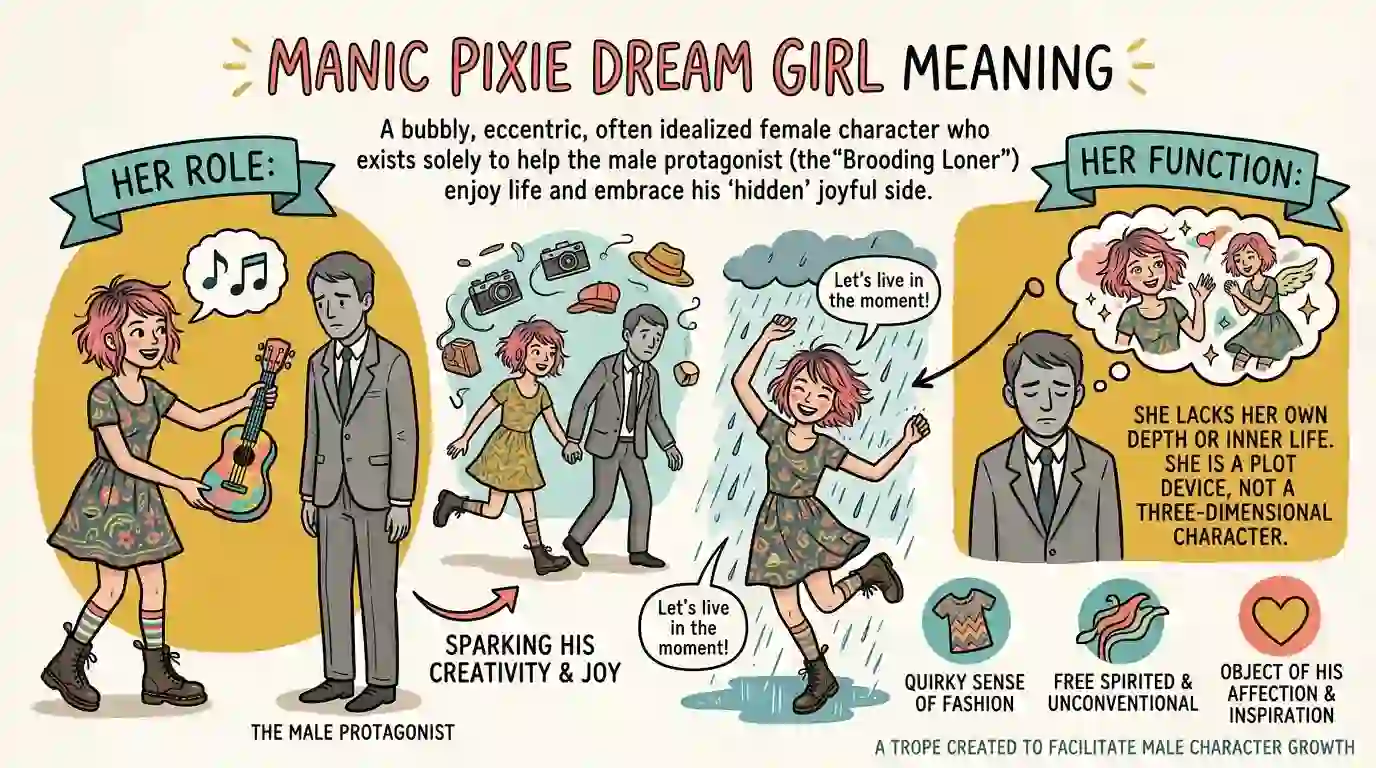
A manic pixie dream girl is a fictional female character, usually in a movie or novel, who is quirky, energetic, and free-spirited but mainly exists to help a troubled male protagonist change his outlook on life. The term criticizes stories that give a woman little independent purpose beyond inspiring a man.
Key Takeaways
- The term describes a character trope, not simply an unusual personality.
- Film critic Nathan Rabin coined the phrase in 2007 while reviewing Elizabethtown.
- Common examples include Claire in Elizabethtown and Sam in Garden State.
- The central criticism is that the female character lacks independent goals and meaningful development.
- A quirky woman is not automatically a manic pixie dream girl.
What Does Manic Pixie Dream Girl Mean?
The phrase manic pixie dream girl describes a fictional woman who brings excitement, romance, or a fresh outlook into the life of a male character who feels lost, sad, or disconnected. She often seems spontaneous, unusual, cheerful, and full of life. Through their relationship, the man learns to take risks, face his feelings, or enjoy life again.
The important detail is her role in the story. Rather than developing as a complete person with her own ambitions, conflicts, and emotional journey, she mainly serves as a source of inspiration for someone else. The phrase is often shortened to MPDG.
For example, imagine a movie about a lonely young man who hates his job and avoids relationships. He meets an adventurous woman who takes him on unexpected trips, introduces him to new music, and teaches him to appreciate everyday moments. By the ending, he has transformed, but viewers know almost nothing about her own hopes or problems. That imbalance is what makes the character fit the trope.
Where Did the Term Come From?
Film critic Nathan Rabin coined manic pixie dream girl in 2007 in a review of Cameron Crowe’s 2005 film Elizabethtown. He used it to describe Claire Colburn, played by Kirsten Dunst, who helps the depressed male protagonist, Drew Baylor, reconnect with life.
The phrase spread through film criticism and online discussions because it gave audiences a memorable way to describe a recurring character pattern. Critics also applied it to characters in other romantic dramas and independent films.
However, the term became controversial in its own right. In 2014, Rabin publicly reflected on how broadly it had been used and expressed regret that it had become a label applied to many unconventional female characters, including characters who did not clearly fit his original description.
This history matters because the phrase was intended as criticism of storytelling, not as a rule that every eccentric woman in fiction must fit the same category.
Common Characteristics of a Manic Pixie Dream Girl
Not every character displays all these traits, but the following patterns can help identify the trope.
- An unconventional personality: She may enjoy unusual hobbies, make unexpected choices, or ignore ordinary social expectations.
- Spontaneous energy: She encourages adventures, sudden trips, or experiences that pull the male protagonist out of his routine.
- A different outlook on life: She helps him see familiar situations in a new way.
- Limited independent goals: Her ambitions and plans receive little attention unless they support his journey.
- Little character development: She may change his life without experiencing an equally meaningful transformation of her own.
- Idealization by the protagonist: The story may present her as a perfect solution to his emotional problems rather than as a person with conflicting needs.
The last two characteristics are especially important. Colorful clothes, unusual music tastes, or a playful personality do not automatically make someone a manic pixie dream girl. The defining issue is how the story treats her as a character.
Famous Manic Pixie Dream Girl Examples
Claire Colburn in Elizabethtown
Claire Colburn is one of the best-known examples because the phrase was coined while reviewing this film. She is an upbeat flight attendant who helps Drew Baylor cope with a personal crisis. Her enthusiasm and unusual approach to life challenge his pessimism. Critics have questioned whether the story gives Claire enough independent depth beyond her influence on Drew.
Sam in Garden State
Sam, played by Natalie Portman in the 2004 film Garden State, is another frequently discussed example. She is spontaneous, quirky, and open about her unusual habits. Her relationship with Andrew helps him reconnect with his emotions and surroundings. Critics have argued that her function in his development receives more attention than her own inner life.
Why Some Characters Are Debated
Other characters, including Clementine in Eternal Sunshine of the Spotless Mind and Ramona Flowers in Scott Pilgrim vs. the World, are sometimes discussed in relation to the trope. However, these labels are open to interpretation. A character may initially seem to fit the pattern while the wider story gives her independent motives, flaws, and a more complex identity.
It is better to examine what a character actually does in the story than to treat every online classification as an established fact.
Why Is the Manic Pixie Dream Girl Trope Criticized?
The main criticism is that the trope can reduce a woman to a tool for a man’s emotional growth. She may seem fascinating, but her purpose is limited to making him happier, braver, or more emotionally aware.
This can create several storytelling problems:
- Unequal character development: The male lead receives a detailed emotional journey while the woman remains mysterious or unexplored.
- Unrealistic expectations: The story can suggest that finding the right romantic partner will solve a person’s deeper problems.
- Limited representation: Female characters may be valued for their charm and inspiration rather than their own decisions and ambitions.
- Confusing personality with purpose: A woman can be unusual and independent, but the story may still frame her mainly through a man’s needs.
The criticism does not mean that romantic partners cannot inspire one another. Healthy relationships often involve mutual encouragement and growth. The problem arises when that support works in only one direction and the woman is denied a meaningful life beyond the relationship.
Manic Pixie Dream Girl vs. a Quirky, Well-Developed Character
A quirky character has unusual interests or behavior. A manic pixie dream girl, in the critical sense, is defined by a narrow narrative function.
| Feature | Manic pixie dream girl trope | Well-developed quirky character |
|---|---|---|
| Purpose | Mainly inspires another character | Has personal goals as well as relationships |
| Inner life | Often underexplored | Includes private concerns, values, and conflicts |
| Character arc | Limited or secondary | Can change, learn, or make difficult choices |
| Relationships | Often centered on the male protagonist | Involve mutual influence and independent needs |
| Personality | Presented as charming or unusual | Can be charming, difficult, inconsistent, or ordinary |
A character can be quirky and still be fully developed. The difference is whether the story treats her as a person or as a solution to somebody else’s problems.
How to Recognize the Trope
When analyzing a movie, book, or TV show, ask these questions:
- Does the female character have goals that matter independently of the male protagonist?
- Does the audience learn about her fears, weaknesses, and personal conflicts?
- Does she make decisions for her own reasons, even when those decisions do not benefit him?
- Does the relationship help both characters grow, or only one?
- Would her story still be interesting if the male protagonist were removed?
These questions are more useful than judging her clothing, hobbies, or energy level. If the character has an independent story and meaningful agency, the label may not fit, even if she appears whimsical or eccentric.
Frequently Asked Questions
What does MPDG stand for?
MPDG stands for Manic Pixie Dream Girl. It is a term used in film and literary criticism for a female character whose main purpose is to inspire a troubled male protagonist, often without receiving an equally developed personal story.
Is being called a manic pixie dream girl a compliment?
It depends on the context, but the phrase is often critical rather than complimentary. It may suggest that someone is being idealized as quirky, exciting, or emotionally helpful instead of being understood as a complete person. Applying it to a real woman can be dismissive, especially when it ignores her individuality.
Is every quirky female character a manic pixie dream girl?
No. Unusual interests, playful behavior, colorful style, or a free-spirited personality are not enough. The label focuses on the character’s role in the narrative, particularly whether she exists mainly to support a man’s development and lacks an independent character arc.
Can a real person be a manic pixie dream girl?
People sometimes use the phrase informally to describe a woman they see as spontaneous, eccentric, or inspiring. However, it originated as a criticism of fictional storytelling. Using it for a real person can reduce her to a fantasy or stereotype, so it is worth considering whether the label is fair or useful.
What is the difference between a muse and a manic pixie dream girl?
A muse inspires another person, often an artist, to create or change. A manic pixie dream girl is a more specific critical trope in which a female fictional character mainly helps a male protagonist grow emotionally. A muse can have her own ambitions and complex identity, so the terms are not interchangeable.
Final Thoughts
The meaning of manic pixie dream girl goes beyond describing a quirky or cheerful woman. It refers to a storytelling pattern in which a female character mainly exists to bring a troubled male protagonist back to life, while her own goals and development receive little attention.
Understanding the trope helps readers and movie fans discuss character writing more precisely. It also offers writers a useful lesson: a memorable female character can inspire others without being reduced to their needs. Give her personal goals, meaningful choices, flaws, and a life beyond the romance, and she becomes more than a fantasy.

I am James Patterson an American writer sharing thoughtful insights on dreams, spirituality, personal growth, and everyday life through practical guides and meaningful stories for SpiritualDreamz.com readers everywhere with warmth.










