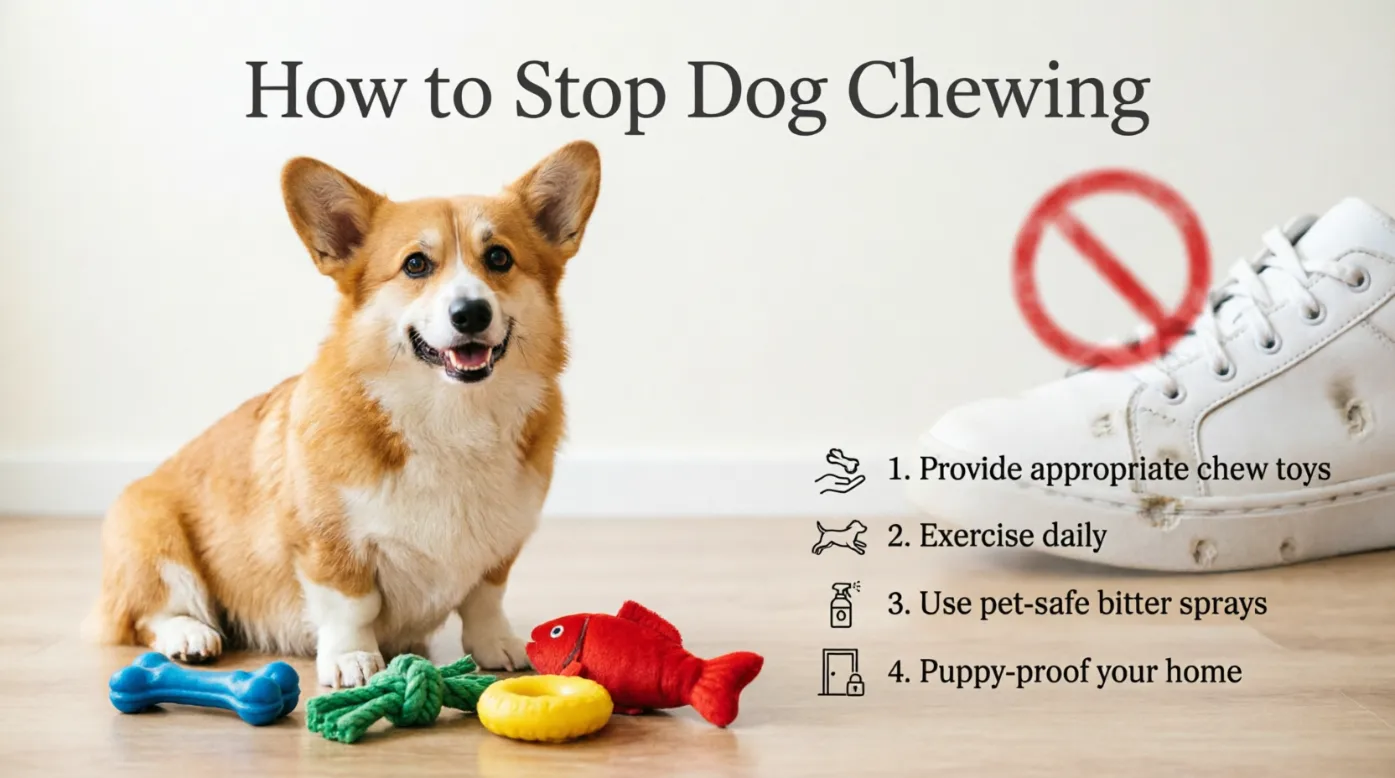
To stop dog chewing, first prevent access to household items, then redirect your dog to appropriate chew toys and reward the right choice. Provide enough exercise and mental stimulation, teach cues such as “leave it” and “drop it,” and supervise your dog until the habit improves. If chewing happens mainly when your dog is alone, anxiety may be involved.
Key Takeaways
- Chewing is normal for dogs, but destructive chewing needs management and training.
- Dog-proof your home and keep tempting objects out of reach.
- Redirect your dog to safe, appealing chew toys instead of simply saying “no.”
- Exercise, play, training, and mental enrichment can reduce boredom-related chewing.
- Persistent chewing, especially when your dog is alone, may indicate anxiety or another problem.
Why Do Dogs Chew?
Before you learn how to stop dog chewing, it helps to understand why your dog is doing it.
Chewing is a normal canine behavior. Dogs explore objects with their mouths, and chewing can provide stimulation and entertainment. Puppies may chew more while their adult teeth are developing, while adult dogs may chew because they are bored, frustrated, anxious, or simply attracted to an interesting object.
The problem is usually not that your dog wants to chew. The problem is what your dog chooses to chew.
Puppies and Teething
Puppies naturally explore their surroundings with their mouths. Teething can make chewing especially appealing because it may help soothe uncomfortable gums.
Instead of trying to eliminate chewing completely, teach your puppy which objects are appropriate.
Boredom and Lack of Stimulation
A dog that does not receive enough physical activity or mental stimulation may find its own entertainment. Shoes, furniture, pillows, books, and other household objects can become interesting targets.
Anxiety and Stress
If your dog destroys doors, windows, furniture, or other objects mainly when you leave, anxiety may be part of the problem. Separation-related behavior can occur alongside barking, pacing, restlessness, urination, or defecation when the dog is alone.
How to Stop Dog Chewing: 9 Practical Steps
1. Remove Tempting Objects
The easiest way to stop inappropriate chewing is to prevent your dog from practicing it.
Put shoes inside closets, keep laundry in a closed hamper, store remote controls and electronics out of reach, and move valuable objects away from areas your dog can access.
Think about your home from your dog’s point of view. If an attractive object is lying on the floor, your dog may consider it an available toy.
Dog-proofing is especially important while you are still training. Both the ASPCA and AKC recommend limiting access to inappropriate objects and creating an environment where the dog can succeed.
2. Give Your Dog Better Things to Chew
Your dog needs an acceptable outlet for its natural chewing instinct.
Offer several appropriately sized chew toys with different textures and shapes. Food-stuffed rubber toys and other interactive options can make appropriate chewing much more rewarding.
If your dog ignores a toy, don’t assume the dog doesn’t like chewing. The toy may simply be less interesting than the forbidden object.
Try rotating toys so that your dog does not have exactly the same options every day.
3. Redirect Chewing Immediately
If you catch your dog chewing your furniture or another forbidden object, calmly interrupt the behavior and offer an appropriate toy.
For example:
Dog chews shoe → interrupt → offer chew toy → dog takes toy → praise and reward.
The important part is teaching your dog what to do instead.
Avoid turning the situation into a chase. If your dog grabs a shoe and you immediately chase after it, your dog may learn that stealing objects creates an exciting game.
4. Teach “Leave It” and “Drop It”
Two useful training cues are “leave it” and “drop it.”
“Leave it” teaches your dog not to take or approach something. “Drop it” teaches your dog to release something already in its mouth. These commands can be useful for everyday behavior and can also help prevent dangerous ingestion.
Practice first with safe, low-value objects in a quiet environment. Reward your dog generously for making the correct choice.
Never forcefully pull an object from your dog’s mouth unless there is an immediate safety emergency. Trading the object for a high-value treat or appropriate toy can make releasing objects easier.
5. Increase Exercise and Mental Stimulation
Exercise can help, but physical activity is only part of the solution.
Dogs also need opportunities to sniff, explore, learn, play, and solve problems. Walks, training sessions, fetch, appropriately played tug, food puzzles, and interactive toys can provide useful enrichment.
A dog that has had appropriate activity and enrichment may be more likely to settle instead of searching for something to destroy.
The exact amount of exercise depends on your dog’s age, breed, health, and individual needs.
6. Rotate Your Dog’s Toys
If every toy is available all the time, some dogs may lose interest.
Keep a selection available and rotate other toys periodically. You can also reserve certain high-value toys for specific situations, such as when you are working or when your dog needs to settle.
Food-stuffed toys can be particularly useful during periods when your dog normally starts chewing.
7. Supervise and Manage Unsupervised Time
Training takes time, so don’t give your dog unlimited freedom before the behavior is reliable.
When you cannot supervise, use a safe, dog-proofed area or another appropriate management arrangement. Remove objects that could be swallowed or destroyed and provide suitable enrichment.
The goal is not to keep your dog confined indefinitely. Management simply prevents repeated mistakes while your dog is learning.
8. Use Chew Deterrents Carefully
A pet-safe taste deterrent may help make certain furniture or other fixed objects less appealing, but it should not be your entire training strategy.
A deterrent does not teach your dog what is appropriate to chew. The better approach is to combine prevention and deterrence with redirection and rewards. The ASPCA specifically notes that deterrents work best as part of a broader behavior-management plan.
Never use a household chemical or substance that could be toxic to your dog.
9. Avoid Punishment After the Fact
If you come home and discover that your dog destroyed a shoe two hours earlier, punishment is unlikely to teach the lesson you want.
Instead, improve prevention for the next opportunity. Dogs learn most effectively when you can respond to the behavior as it happens and immediately reinforce the behavior you want.
Harsh punishment can also create fear or increase anxiety in some dogs.
How to Stop a Dog From Chewing Furniture and Shoes
Furniture and shoes are common targets because they are accessible, interesting, and may carry familiar human scents.
Use this simple routine:
- Block access to the furniture or remove the shoes.
- Supervise your dog when it has access to the room.
- Interrupt calmly if chewing starts.
- Offer an appropriate chew toy.
- Praise the dog for chewing the toy.
- Repeat consistently.
Do not give your dog old shoes as toys if you want your dog to stop chewing shoes. That can make the distinction confusing. The ASPCA recommends avoiding household objects as dog toys for this reason.
What If Your Dog Chews Only When You Leave?
Pay special attention if your dog behaves normally while you are home but becomes destructive shortly after you leave.
Chewing that occurs specifically during your absence can be associated with separation anxiety. A camera can help you see what happens after you leave and provide useful information about the behavior.
Don’t assume the solution is simply “give the dog more toys.” If your dog is experiencing significant anxiety, the underlying problem needs to be addressed.
A veterinarian or qualified veterinary behavior professional can help determine if anxiety is involved and recommend an appropriate treatment plan.
How to Choose Safe Chews
Not every chew is appropriate for every dog.
Choose products according to your dog’s size, chewing style, and ability to break off pieces. Watch your dog while using a new chew, and remove it if it becomes small enough to swallow or starts breaking apart.
The ASPCA warns that some chews can create choking or intestinal-obstruction risks when dogs swallow large pieces. Even durable products can become unsafe when excessively worn.
Avoid giving dogs cooked bones such as leftover chicken or steak bones. Bones can splinter and cause serious injuries.
Also keep household hazards completely out of reach. Dogs that chew can accidentally ingest medications, cleaning products, batteries, certain foods, and other dangerous items. If you suspect your dog has swallowed something toxic, contact a veterinarian or animal poison-control service promptly.
When to Talk to a Veterinarian or Behavior Professional
Most inappropriate chewing can improve with better management, enrichment, and consistent training. However, don’t ignore sudden or extreme changes in chewing behavior.
Talk with your veterinarian if:
- An adult dog suddenly starts chewing excessively.
- Your dog appears to have mouth or dental pain.
- Your dog repeatedly swallows non-food objects.
- Chewing happens mainly when your dog is alone.
- Your dog shows signs of significant anxiety or distress.
- Your dog becomes aggressive when you try to take an object away.
- Your dog may have swallowed a dangerous object.
Excessive chewing in an adult dog can sometimes be associated with oral pain or anxiety, so the cause matters when deciding how to treat it.
Frequently Asked Questions
Does chewing mean my dog is bored?
Not always. Chewing is normal behavior, particularly in puppies, but boredom and insufficient exercise or mental stimulation can contribute to destructive chewing. Anxiety, teething, exploration, and simple preference for certain textures or scents can also play a role.
Should I punish my dog for chewing?
No. Avoid punishing your dog after discovering damage. Instead, prevent access, interrupt inappropriate chewing when you catch it, redirect your dog to an appropriate object, and reward the correct behavior. This gives your dog a clearer lesson about what you want it to do.
Will my puppy grow out of chewing?
Puppies generally chew frequently while exploring and teething, and chewing may decrease as they mature. However, puppies still need training and appropriate chew outlets. If they repeatedly practice chewing furniture, shoes, or other household objects, the habit can become difficult to manage later.
What command should I teach a dog that steals things?
Teach both “leave it” and “drop it.” “Leave it” helps your dog avoid an object, while “drop it” teaches the dog to release something already in its mouth. Practice these skills with positive reinforcement before you need them in an emergency.
How long does it take to stop destructive chewing?
There is no universal timeline. Puppies, adult dogs, and dogs with anxiety may improve at different rates. Consistent management is important because every opportunity to chew forbidden objects can reinforce the habit. Focus on preventing mistakes while repeatedly rewarding appropriate chewing.
Conclusion
The best way to stop dog chewing is not to eliminate chewing altogether. Teach your dog where chewing is appropriate.
Dog-proof your home, provide appealing and safe chew options, redirect inappropriate chewing, teach “leave it” and “drop it,” and give your dog enough physical and mental enrichment. If chewing occurs mainly when your dog is alone or seems unusually intense, investigate possible anxiety or medical causes with your veterinarian.
With consistent management and positive training, most owners can make appropriate chewing a much more rewarding choice than destroying household items.

I am Toni Morrison an acclaimed American novelist and Nobel Prize winner whose powerful storytelling explored identity, memory, love, heritage, and the human spirit through unforgettable literary works at Spiritualdreamz.com.










