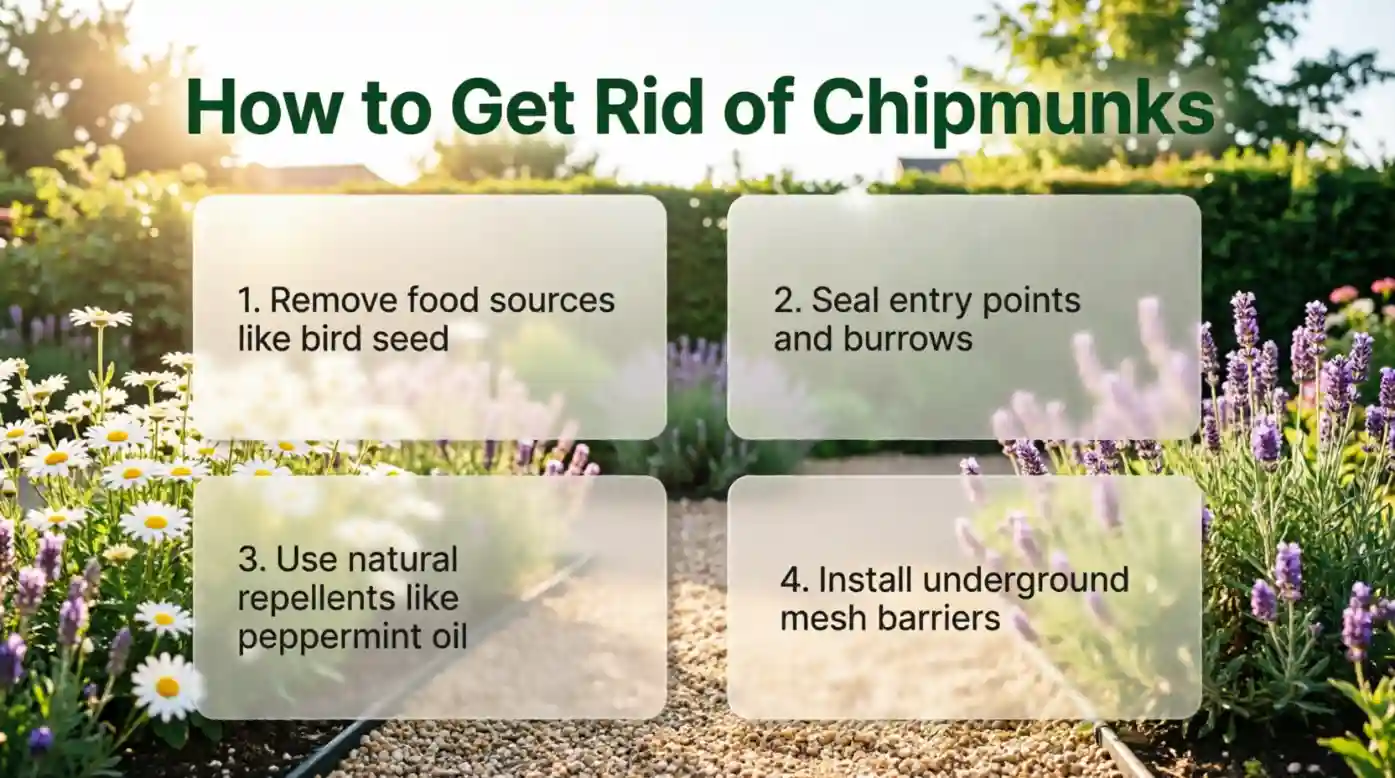
The best way to get rid of chipmunks is to combine several methods: remove food and hiding places, keep birdseed and pet food secured, block access with ¼-inch hardware cloth, protect gardens and bulbs with mesh barriers, and use humane trapping when necessary. For chipmunks inside a building or causing serious structural problems, professional wildlife control may be the safest option.
Key Takeaways
- Remove birdseed, pet food, fallen fruit, nuts, and other easy food sources.
- Clear woodpiles, brush, rocks, and dense vegetation near structures.
- Use ¼-inch hardware cloth to block openings and protect gardens.
- Repellents may help, but they usually work better as part of a larger strategy.
- If trapping is necessary, follow local wildlife rules and avoid handling wild animals directly.
Find Out Why Chipmunks Are on Your Property
Before trying to remove chipmunks, look for the reason they keep returning. Chipmunks are attracted to properties that provide three basic things: food, shelter, and suitable places to burrow.
Common food sources include spilled birdseed, nuts, berries, seeds, garden plants, and pet food. They may also use woodpiles, rock piles, dense shrubs, ground cover, and landscaping near foundations as protected areas.
A typical chipmunk burrow can be surprisingly difficult to spot. Penn State Extension notes that entrances are often around 2 inches wide and may not have a noticeable mound of dirt because chipmunks carry excavated soil away in their cheek pouches.
Look for small holes around patios, steps, retaining walls, gardens, woodpiles, or foundations. You may also notice damaged bulbs, disturbed soil, missing seeds, or chipmunks repeatedly traveling along the same paths.
Remove Food Sources
One of the simplest ways to make your property less attractive is to remove easy meals.
Start with bird feeders. Spilled seed on the ground can attract chipmunks even when the feeder itself is elevated. Clean up spilled seed regularly and consider moving feeders farther from the house.
Also:
- Store birdseed in sealed, rodent-resistant containers.
- Keep pet food indoors instead of leaving bowls outside.
- Pick up fallen fruit and nuts when practical.
- Keep garbage containers securely closed.
- Harvest ripe garden produce promptly.
- Clean up food scraps around outdoor eating areas.
You don’t necessarily have to stop feeding birds. The goal is to reduce the amount of food available to chipmunks around the areas you want to protect.
Remove Hiding Places and Cover
Chipmunks prefer protected routes where predators cannot easily reach them. Landscaping can unintentionally create these routes.
Move woodpiles, brush, piles of rocks, and other clutter away from foundations and areas where chipmunks are causing problems. Trim vegetation that creates a continuous covered path from wooded areas toward your house.
Keeping the area immediately around a building more open also makes burrows and entry points easier to spot.
This approach is called habitat modification. Instead of simply trying to scare the animals away, you make the property less attractive and less convenient for them.
Block Chipmunk Entry Points
If chipmunks are getting underneath a porch, into a crawlspace, or inside another part of your home, exclusion is one of the most important long-term solutions.
Inspect the exterior of your house for gaps around:
- Foundation openings
- Vents
- Utility lines
- Crawlspaces
- Porches
- Decks
- Doors
- Drainage and other openings
For many openings, ¼-inch galvanized hardware cloth is a useful barrier. Kansas State Extension recommends ¼-inch hardware cloth for excluding chipmunks from buildings and protecting flower beds.
Don’t simply plug an opening while an animal may still be inside. First make sure the chipmunk has left. Otherwise, you could trap an animal inside the structure.
For difficult entry points, especially around roofs, walls, or inaccessible crawlspaces, a wildlife professional can help identify the entry route and install exclusion materials correctly.
Protect Your Garden and Flower Beds
If your main problem is chipmunks digging up bulbs or eating plants, you may not need to remove every chipmunk from the property.
Instead, protect the areas that matter most.
A physical mesh barrier can be highly effective. Use appropriately sized hardware cloth over vulnerable beds or around individual plants. For buried barriers, the mesh needs to extend below ground because chipmunks are capable diggers.
Penn State Extension recommends ¼-inch hardware cloth for protecting flower beds, seeds, and bulbs. Extension guidance also recommends burying fencing or barriers to prevent animals from simply digging underneath.
You can also consider planting bulbs that wildlife tend to avoid. Daffodils and members of the Allium family are commonly suggested as alternatives for areas where bulb damage is a recurring problem.
Try Repellents Carefully
Repellents can be useful, but they should not be your only strategy.
Research-based wildlife-management guidance identifies products containing ingredients such as capsaicin, thiram, Bitrex, or certain ammonium soaps as possible options for protecting plants and bulbs. However, effectiveness varies, applications may need to be repeated, and repellents generally do not provide complete control.
Always read the product label and make sure the product is legal and appropriate for the intended use in your state.
What About Vinegar?
Vinegar is frequently recommended online because strong smells may temporarily discourage some animals. However, it should not be considered a reliable long-term solution for a chipmunk problem.
If chipmunks have food, shelter, and easy access to your property, a temporary odor is unlikely to solve the underlying problem.
Do Ultrasonic Devices Work?
Don’t depend on ultrasonic or frightening devices as your main solution. Research-based wildlife-control information reports that frightening devices are not effective for controlling chipmunks.
Physical exclusion and habitat modification are generally more dependable because they address how chipmunks actually use the property.
Use Live Trapping When Necessary
If chipmunks continue causing significant damage after you’ve removed food and improved exclusion, trapping may be an option.
Penn State Extension identifies trapping as a practical control method in many residential situations. Live-catch traps can be placed along established chipmunk travel routes and baited with foods such as nuts or seeds.
If you use a live trap:
- Place it where you have repeatedly seen chipmunks traveling.
- Secure the trap so it cannot easily move.
- Consider pre-baiting before activating it so the animal becomes accustomed to the trap.
- Check the trap frequently.
- Keep children and pets away from the trap.
- Avoid direct contact with the captured animal.
- Follow your state and local wildlife regulations concerning trapping and relocation.
Relocating wildlife is not necessarily legal everywhere, and moving an animal to another location can create problems for both the animal and other wildlife. Check with your state wildlife agency or local animal-control authority before relocating a trapped chipmunk.
If you are uncomfortable trapping wildlife yourself, a qualified wildlife-control professional can handle the process.
Deal With Chipmunks Inside the House
A chipmunk inside a living area usually needs a different approach from chipmunks living in the yard.
Keep children and pets out of the room. Close interior doors so the animal cannot move throughout the house, then provide a clear route to the outdoors by opening an exterior door or window when practical.
Give the animal space to leave rather than chasing it around the room.
If it cannot find an exit, a properly sized live trap may be an option. Humane World for Animals recommends giving an indoor chipmunk a clear escape route and avoiding unnecessary handling.
After the animal leaves, find the entry point and repair it. Otherwise, another chipmunk may eventually use the same opening.
Wild animals should not be handled casually. The CDC recommends keeping your distance from wildlife because animals can bite or scratch when frightened, and wildlife can carry diseases. If you are bitten or scratched, wash the wound promptly with soap and water and seek appropriate medical advice.
When to Call a Wildlife Professional
DIY methods are reasonable when you have a few chipmunks visiting a yard or garden. Professional help makes more sense when the situation is harder to control.
Consider professional wildlife control if:
- Chipmunks are repeatedly entering your house.
- You hear scratching inside walls or ceilings.
- Burrows are directly under structures.
- You cannot locate the entry point.
- You have tried exclusion but the animals keep returning.
- Trapping is difficult or unsafe.
- You are concerned about pets or children.
- You suspect an animal may be trapped inside a wall or crawlspace.
The goal should not simply be to remove the current animal. A good solution also addresses why the property attracted chipmunks in the first place.
Frequently Asked Questions
What is the fastest way to get rid of chipmunks?
The fastest practical approach is usually a combination of food removal, habitat modification, physical exclusion, and trapping when appropriate. Removing spilled birdseed and other food can reduce attraction, while hardware cloth can stop access to gardens and structures. A single repellent usually won’t solve an established problem.
What naturally keeps chipmunks away?
Removing food and shelter is more dependable than relying on a strong-smelling household ingredient. Keep birdseed contained, clean up fallen food, move woodpiles and debris away from structures, and protect vulnerable plants with mesh. Some gardeners also use daffodils or Allium bulbs because wildlife generally avoids them.
Will vinegar get rid of chipmunks?
Vinegar is not a dependable long-term chipmunk-control method. Even if a strong smell temporarily discourages an animal, it does not remove food, shelter, or access to a burrow. Physical barriers and habitat modification are better long-term strategies.
Should I fill in a chipmunk hole?
Don’t immediately fill an active burrow if you don’t know if a chipmunk is inside. First confirm that the animal has left and identify if the burrow is creating a genuine problem. Once you are certain it is inactive, repair the area and improve the surrounding exclusion so another animal cannot easily establish a new burrow.
How do I keep chipmunks out of my garden?
Use a physical barrier rather than relying entirely on repellents. Hardware cloth with approximately ¼-inch mesh can be used to protect vulnerable garden areas, bulbs, and plants. Because chipmunks can dig, the barrier should also extend below ground. Remove spilled seed and other food sources nearby to make the garden less attractive.
Conclusion
Learning how to get rid of chipmunks is less about finding one miracle repellent and more about making your property difficult and unattractive for them to use.
Start by removing food sources and unnecessary cover. Then protect gardens and vulnerable areas with hardware cloth and seal openings that lead into buildings. If the problem continues, trapping may be appropriate, provided you follow local regulations and handle wildlife safely.
For serious infestations, difficult entry points, or chipmunks living inside a structure, professional wildlife control can help you solve the underlying problem instead of repeatedly dealing with the same animals.

I am Stephen King an American writer exploring spirituality, dreams, mindfulness, and personal growth. Through SpiritualDreamz.com, he shares thoughtful insights to inspire reflection, clarity, and meaningful everyday living.










