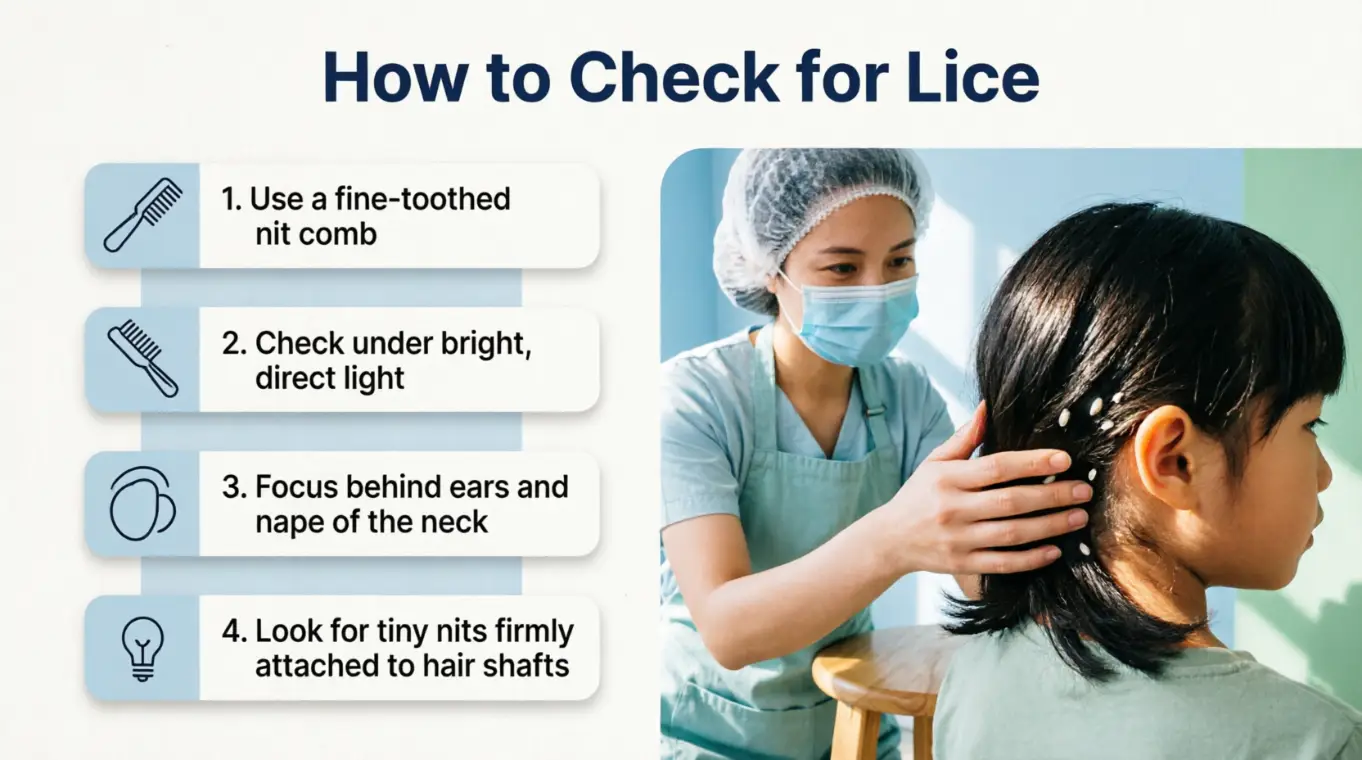
To check for lice, examine the scalp and hair under bright light, separating the hair into small sections. Look for live crawling lice or firmly attached nits, especially behind the ears and near the back of the neck. A fine-toothed lice comb can help. Finding a live louse is the most reliable way to confirm an active head-lice infestation.
Key Takeaways
- Live crawling lice are the strongest evidence of an active head-lice infestation.
- Check carefully behind the ears, around the hairline, and at the nape of the neck.
- Nits are firmly attached to individual hairs and are harder to remove than dandruff.
- Nits more than about ¼ inch (6 mm) from the scalp are usually dead, hatched, or from an older infestation.
- Itching can occur with lice, but itching alone does not prove you have lice.
What Do Lice Look Like?
Head lice are very small insects that live on the scalp and feed on blood. Adult lice are roughly the size of a sesame seed and can move quickly, making them difficult to spot. Nymphs are younger lice and are even smaller.
Lice eggs, commonly called nits, are attached firmly to individual hair shafts. They may appear yellow, brown, tan, or, after hatching, clear or whitish. Unlike loose flakes, nits do not easily brush or shake out of the hair.
Because lice avoid light and move quickly, you may have difficulty finding a live louse during a quick visual inspection. That’s why a bright light and fine-toothed comb can make checking easier.
How to Check for Lice at Home
You can usually inspect someone’s scalp and hair at home using a bright light and a fine-toothed lice or nit comb. The American Academy of Dermatology recommends wetting the hair when possible, separating it into sections, and slowly combing from the scalp outward.
1. Use bright light
Have the person sit somewhere with strong lighting. A bright bathroom light or daylight can make tiny lice and nits easier to see.
A magnifying glass can also help when you’re unsure if a small object is a nit, dandruff, or another piece of debris.
2. Separate the hair into sections
Part the hair into small sections so you can see the scalp clearly.
Start near the scalp and work systematically rather than randomly looking over the surface of the hair. Move through the entire head one section at a time.
If the hair is long or thick, clips can help keep inspected sections separate.
3. Check the scalp and hair
Look for two main things:
Live lice:
These are tiny crawling insects. They may move quickly when exposed to light, so watch closely for movement rather than expecting them to remain still.
Nits:
These are eggs attached firmly to individual hairs. They are usually close to the scalp when they are viable.
Finding a live nymph or adult louse is the best way to confirm an active infestation.
4. Pay special attention to key areas
Certain areas are particularly important to examine:
- Behind both ears
- Around the hairline
- At the nape of the neck
- Near the scalp
- Around the crown and bangs
The CDC specifically recommends examining areas such as the crown, bangs, behind the ears, and nape of the neck when checking for head lice.
5. Use a fine-toothed lice comb
A lice or nit comb has closely spaced teeth designed to catch small lice and nits.
If possible, wet the hair before combing. The American Academy of Dermatology recommends separating the hair into sections and slowly combing from the scalp toward the ends.
After each pass, inspect the comb carefully. You can wipe it onto a white tissue or paper towel to make tiny insects or eggs easier to notice.
Continue section by section until you’ve examined the entire scalp.
How to Tell Lice From Dandruff and Other Debris
One of the biggest problems with checking for lice is mistaking ordinary particles in the hair for nits.
Dandruff, lint, dirt, hair-product residue, and other particles can look similar to lice eggs. The main difference is how firmly they are attached.
Nits:
- Firmly attached to individual hairs
- Difficult to slide or remove
- Usually found close to the scalp when associated with an active infestation
- May be yellow, brown, tan, or clear after hatching
Dandruff or loose debris:
- Usually flakes or particles
- Easier to brush, flick, or remove
- Not cemented to the hair shaft
The CDC notes that misdiagnosis is common because nits can be confused with dandruff and other particles.
If you’re unsure if something is a nit, don’t assume you have lice based on one tiny speck. Look for a live louse or have a healthcare professional help identify what you’re seeing.
What Do Lice Eggs and Nits Look Like?
Nits are tiny eggs attached to individual hairs. They can be easier to see than adult lice because they remain attached to the hair instead of moving around.
Location matters, too.
Nits found within about ¼ inch (6 mm) of the scalp are more concerning for a current infestation. Nits farther away from the scalp are generally unlikely to be viable and may represent eggs that have already hatched or died.
This does not mean every nit close to the scalp automatically proves live lice are present. A live louse is the clearest confirmation.
Does Itching Always Mean You Have Lice?
No. An itchy scalp is a common symptom of head lice, but itching by itself does not confirm an infestation.
Dandruff, eczema, skin irritation, allergies, and other scalp conditions can also cause itching. Some people with head lice may not experience itching immediately, and some may not itch at all.
Other possible signs include a crawling sensation, visible lice, nits attached to hair, or irritation caused by repeated scratching.
For that reason, inspect the scalp and hair rather than relying only on symptoms.
What to Do If You Find Lice
If you find a live louse, you should treat the finding seriously because live lice indicate an active infestation.
Check other household members as well, particularly if they have had close head-to-head contact with the affected person. CDC guidance recommends examining household members every 2–3 days when someone has head lice and treating people who have live crawling lice or nits close to the scalp.
If treatment is needed, follow the product instructions carefully. Both over-the-counter and prescription treatments are available, and a pharmacist or healthcare professional can help you choose an appropriate option.
After treatment, CDC guidance recommends checking the hair and removing lice and nits with a nit comb every 2–3 days for the following 2–3 weeks, while following the specific treatment instructions.
Avoid treating someone simply because you see an uncertain white speck in the hair. Correct identification matters because misdiagnosis of head lice is common.
When to See a Healthcare Professional
Consider getting professional help if:
- You cannot tell if the suspected particles are lice or dandruff.
- You cannot find a live louse but remain concerned about an infestation.
- Treatment does not appear to work.
- The scalp has significant sores or signs of infection from scratching.
- You’re unsure which treatment is appropriate.
A healthcare professional can examine the scalp and hair with a fine-toothed comb and, when necessary, magnification.
Frequently Asked Questions
Can you see lice with the naked eye?
Yes. Adult and nymph head lice can be seen without magnification, but they are very small and move quickly. Bright light, careful sectioning, a magnifying lens, and a fine-toothed lice comb can make them easier to find.
How do you check yourself for lice?
Use a mirror and bright light, or ask another person to inspect your scalp. Separate the hair into small sections and look closely near the scalp, behind the ears, and at the nape of the neck. A fine-toothed lice comb can make the examination easier.
Can you have lice without itching?
Yes. Itching is common, but it does not occur immediately in everyone and some people may not experience it. That’s why finding live lice or identifying characteristic nits is more useful than relying on itching alone.
Are nits always a sign of active lice?
No. Nits farther than about ¼ inch from the scalp are usually hatched or dead and generally indicate an older infestation rather than active lice. Finding live crawling lice is the strongest evidence of an active infestation.
Where are lice usually found?
Head lice and their nits are commonly found close to the scalp, especially behind the ears and around the back of the neck. These areas should receive careful attention during an inspection.
What is the fastest way to check for lice?
The most practical approach is to use bright light, divide the hair into small sections, inspect the scalp and hair carefully, and slowly run a fine-toothed lice comb from the scalp through the hair. Look especially behind the ears and at the nape of the neck.
Conclusion
Knowing how to check for lice can help you identify an infestation early and avoid unnecessary treatment. Carefully examine the scalp and hair under bright light, paying close attention to behind the ears and the back of the neck. Look for live crawling lice and firmly attached nits, and use a fine-toothed lice comb for a more thorough check.
Remember that itching or finding a white speck in the hair does not automatically mean you have lice. If you find a live louse or are unsure about what you see, consider speaking with a healthcare professional for confirmation and appropriate treatment.

I am James Patterson an American writer sharing thoughtful insights on dreams, spirituality, personal growth, and everyday life through practical guides and meaningful stories for SpiritualDreamz.com readers everywhere with warmth.










