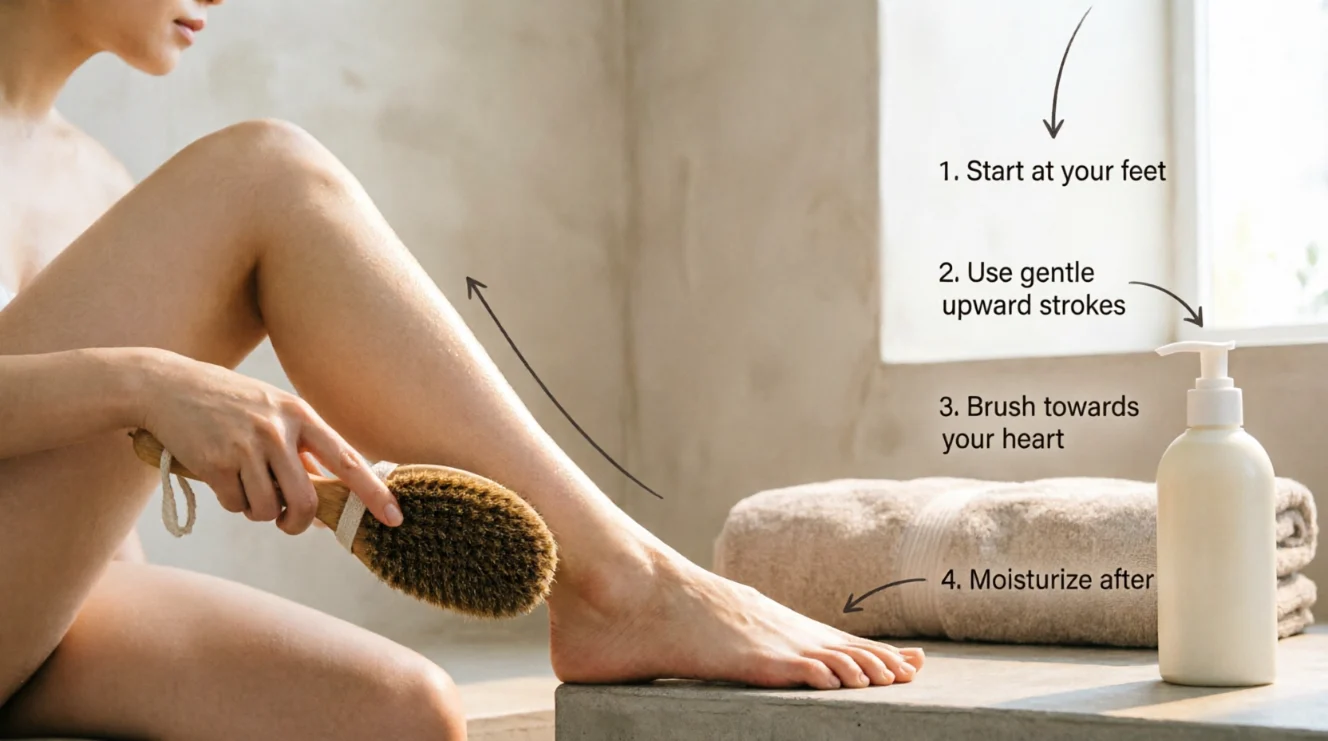
To dry brush your body, use a clean, natural-bristle body brush on completely dry skin before showering. Start at your feet and use gentle, upward strokes toward your torso, then brush your arms toward your armpits. Use lighter pressure on sensitive areas, avoid broken or irritated skin, shower afterward, and moisturize.
Key Takeaways
- Dry brushing is primarily a form of physical exfoliation that removes loose, dead skin cells.
- Use a clean body brush on dry skin before your shower or bath.
- Start at your feet and work upward with light, comfortable strokes.
- Avoid cuts, wounds, sunburn, rashes, infections, moles, and irritated skin.
- Dry brushing may make skin feel smoother, but claims about detoxing or permanently removing cellulite are not well supported by research.
What Is Dry Brushing?
Dry brushing is a body-care technique that involves moving a dry brush across dry skin before bathing or showering. The brush physically exfoliates the outer layer of the skin, helping remove loose, dead skin cells.
The practice has become popular as part of wellness and skincare routines. People often use it because their skin feels smoother afterward and because the brushing motion can feel similar to a light massage.
However, it is important to keep expectations realistic. Exfoliation is the clearest benefit. Claims that dry brushing can “detox” the body, cure health conditions, or permanently eliminate cellulite are not supported by strong evidence. [1][2]
How to Dry Brush Your Body Step by Step
If you’re learning how to dry brush for the first time, keep the process simple. You do not need to scrub hard or spend a long time brushing each area.
1. Choose the Right Brush
Use a body brush with firm but comfortable bristles. A long handle can make it easier to reach your back and other hard-to-reach areas.
If your skin is sensitive, start with a softer brush or even a dry washcloth. The goal is to exfoliate without causing pain, burning, scratching, or significant redness.
Keep your personal brush clean, and do not share it with other people.
2. Start With Dry Skin
Dry brushing is normally done before a shower or bath, when both your skin and brush are dry.
Stand somewhere that is easy to clean afterward, such as your bathroom. You can brush over a towel or inside an empty shower if you want to catch loose flakes of skin.
Do not apply body oil or lotion before brushing. Save moisturizing for afterward.
3. Begin at Your Feet
Start at one foot and use long, gentle strokes moving upward toward your ankle and lower leg.
You can use a few overlapping strokes rather than repeatedly brushing the same spot. The sensation should feel stimulating but comfortable.
Move to the other foot and repeat the process.
4. Move Up Your Legs
Continue from your ankles toward your calves, knees, and thighs.
Use longer strokes on your legs and adjust the pressure depending on how your skin feels. Areas with thinner or more sensitive skin require a lighter touch.
You do not need to press hard to make dry brushing effective. More pressure does not automatically mean better exfoliation.
5. Brush Your Torso and Back
Once you finish your legs, move to your abdomen, sides, chest, and back.
For larger areas of the torso, gentle circular motions can be comfortable. Use extra care around sensitive areas such as the breasts, abdomen, and neck.
If your brush has a long handle, use it to reach your back without twisting your body awkwardly.
6. Finish With Your Arms
Start at your hands or wrists and work upward toward your shoulders.
Use gentle strokes along your forearms and upper arms, gradually moving toward your armpits.
The skin on the inner arms can be more delicate, so reduce the pressure if the brush feels scratchy or uncomfortable.
7. Shower and Moisturize
After brushing your entire body, take a shower or bath to rinse away loosened skin cells.
You do not need extremely hot water. Afterward, gently pat your skin dry and apply a moisturizer while the skin is still slightly damp.
Moisturizing is particularly useful if your skin tends to become dry after exfoliation.
How Much Pressure Should You Use?
Use light to moderate pressure enough to feel the brush moving across your skin but never enough to cause pain.
A common mistake is assuming that red skin means the brush is working. It does not. Strong redness, burning, bleeding, swelling, or soreness is a sign that you should stop or reduce the pressure.
Cleveland Clinic recommends using only a few overlapping strokes over each area because excessive brushing can irritate or even damage the skin.
A good rule is:
Firm enough to exfoliate, gentle enough that your skin stays comfortable.
How Often Should You Dry Brush?
There is no single schedule that works for everyone.
If you are a beginner, start about once a week and see how your skin responds. If your skin tolerates it well, some people may gradually increase the frequency.
More frequent brushing is not necessarily better. Repeated physical exfoliation can cause dryness and irritation, particularly if you use too much pressure.
Your skin’s response should guide your routine. If you develop persistent redness, soreness, itching, or irritation, stop and allow your skin to recover.
What Are the Benefits of Dry Brushing?
Exfoliates Dead Skin
The most straightforward benefit of dry brushing is physical exfoliation. The bristles can remove loose, dead skin cells from the surface, which may leave the body feeling smoother and softer.
This is why dry brushing is best viewed as a skincare technique rather than a medical treatment.
May Temporarily Improve the Look of Skin
Removing surface flakes can make skin look smoother and temporarily brighter.
The brushing action may also increase blood flow to the skin for a short period, which can make the skin appear temporarily more flushed or plump.
That does not mean dry brushing permanently changes the structure of your skin.
Can Feel Relaxing
Some people enjoy dry brushing because the repetitive brushing sensation feels similar to a gentle massage.
This can make it an enjoyable part of a personal-care routine, especially when done slowly rather than aggressively.
Does Dry Brushing Help With Cellulite or Detox?
This is where it is important to separate skincare benefits from marketing claims.
There is no strong evidence that dry brushing permanently reduces cellulite. Some people may notice a temporary change in the appearance of their skin after brushing, but this should not be confused with removing cellulite. Cleveland Clinic specifically notes that evidence does not support dry brushing as a cellulite treatment.
The same applies to “detox” claims. Your body already has organs and systems responsible for processing and eliminating waste. Although dry brushing may temporarily stimulate the skin and circulation, there is limited scientific evidence that it “detoxes” the body.
So if you enjoy dry brushing, use it for what it can realistically offer: exfoliation, a smoother skin feel, and a pleasant body-care ritual.
Who Should Avoid Dry Brushing?
Dry brushing is not appropriate for every person or every area of skin.
Do not brush over:
- Open wounds or cuts
- Scrapes
- Sunburn
- Rashes
- Active infections
- Inflamed or irritated skin
- Areas affected by eczema or psoriasis
- Moles, warts, or raised skin growths
- Skin that becomes painful or swollen during brushing
People with sensitive skin or a skin condition should consider asking a dermatologist if dry brushing is appropriate for them.
Cleveland Clinic also advises against dry brushing the face with a regular body brush because facial skin is more delicate.
If you experience persistent irritation after brushing, stop rather than trying to “push through” it.
Common Dry-Brushing Mistakes
Brushing too hard: More pressure can cause irritation without providing extra benefits.
Brushing irritated skin: Exfoliating already inflamed or damaged skin can make the problem worse.
Spending too long on one area: A few gentle passes are usually enough.
Using a dirty brush: Clean your brush regularly and allow it to dry completely.
Expecting cellulite to disappear: Dry brushing cannot be relied upon as a permanent cellulite treatment.
Skipping moisturizer: Exfoliation can leave some people feeling dry, so moisturizing afterward is a simple way to support comfortable skin.
Dry brushing the face with a body brush: The face needs gentler products and tools designed specifically for facial skin.
Frequently Asked Questions
Should I dry brush before or after a shower?
Dry brush before your shower or bath. This lets you rinse away loosened skin cells afterward. Once you finish bathing, gently dry your skin and apply moisturizer.
Can I dry brush every day?
Some professional guidance allows daily dry brushing, but daily exfoliation is not necessary for everyone. Beginners may want to start less frequently and see how their skin responds. If your skin becomes dry, sore, red, or irritated, reduce the frequency or stop.
Should I dry brush my face?
A regular body dry brush should not be used on the face. Facial skin is more delicate than most body skin. If you want to try facial dry brushing, use a tool specifically designed for the face and be especially gentle.
Do I need to moisturize after dry brushing?
It is a good idea to moisturize after showering. Physical exfoliation can leave skin feeling dry, and applying a moisturizer afterward helps keep the skin comfortable and hydrated.
Does dry brushing help lymphatic drainage?
Dry brushing is often promoted as a way to support lymphatic drainage, but strong evidence specifically demonstrating this benefit is lacking. Some forms of massage can affect lymph movement, but that does not prove that ordinary dry brushing provides the same medical effect.
Conclusion
Learning how to dry brush is simple: use a clean brush on dry skin, begin at your feet, work upward with comfortable strokes, use less pressure on sensitive areas, and shower afterward.
The most realistic reason to dry brush is gentle physical exfoliation. It can leave your skin feeling smoother and may make a relaxing addition to your body-care routine. But avoid aggressive brushing and be skeptical of claims that it can detox your body or permanently eliminate cellulite.
If you have eczema, psoriasis, very sensitive skin, an active rash, wounds, or another skin concern, ask a healthcare professional before adding dry brushing to your routine.

I am Stephen King an American writer exploring spirituality, dreams, mindfulness, and personal growth. Through SpiritualDreamz.com, he shares thoughtful insights to inspire reflection, clarity, and meaningful everyday living.










