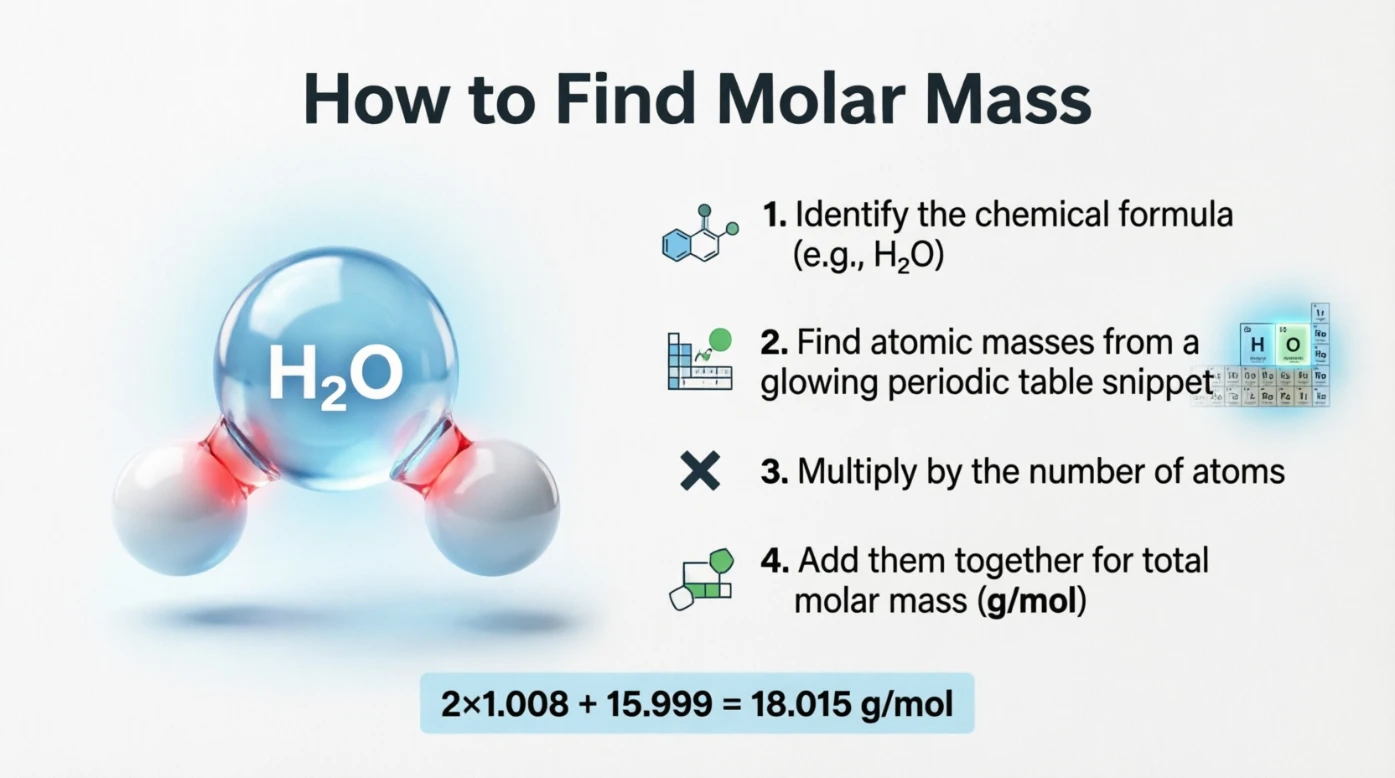
To find molar mass, add the atomic masses of all the atoms in a chemical formula. First, identify each element and count its atoms using the subscripts. Next, multiply each element’s atomic mass by its number of atoms. Finally, add the results together. The answer is the molar mass, expressed in grams per mole (g/mol).
Key Takeaways
- Molar mass is the mass of one mole of a substance, measured in g/mol.
- Use the periodic table to find each element’s atomic mass.
- Multiply each atomic mass by the number of atoms in the chemical formula.
- Add all the results to calculate the total molar mass.
- Remember to count every atom inside parentheses and include water in hydrated compounds.
What Is Molar Mass?
Molar mass is the mass of one mole of a substance. A mole represents approximately 6.022×10236.022 \times 10^{23}6.022×10²³ particles, such as atoms, molecules, or formula units.
Molar mass is measured in grams per mole (g/mol). It helps chemists convert between the mass of a substance and the number of moles.
For example, the molar mass of water (H₂O) is approximately 18.02 g/mol. This means that one mole of water has a mass of 18.02 grams.
You can calculate the molar mass of an element, a molecule, or an ionic compound by using its chemical formula and the periodic table.
Molar Mass vs. Molecular Mass
Molar mass and molecular mass are closely related, but they have different units.
| Molar mass | Molecular mass |
| Mass of one mole of a substance | Mass of one molecule |
| Measured in g/mol | Measured in atomic mass units (u) |
| Used in mole calculations | Describes the mass of an individual molecule |
For example, a water molecule has a molecular mass of approximately 18.02 u, while water has a molar mass of approximately 18.02 g/mol.
What Is the Formula for Molar Mass?
The formula for calculating molar mass is:
M = Σ (n × A)
Molar mass formula
Where:
- M = molar mass (g/mol)
- Σ = sum of all the elements
- n = number of atoms of each element
- A = atomic mass of each element
For example, if a compound contains two hydrogen atoms and one oxygen atom, multiply hydrogen’s atomic mass by two and oxygen’s atomic mass by one. Add both results to find the molar mass.
How to Find Molar Mass Step by Step
You can calculate the molar mass of most substances using four simple steps.
Step 1: Write the Chemical Formula
Start by identifying the chemical formula of the substance. The formula tells you which elements are present and how many atoms of each element are included.
For example, water has the chemical formula H₂O. It contains two hydrogen atoms and one oxygen atom.
Remember that when an element has no subscript, its atom count is one.
Step 2: Find the Atomic Mass of Each Element
Use the periodic table to find the atomic mass of every element in the formula.
For example:
| Element | Symbol | Atomic mass |
| Hydrogen | H | 1.008 |
| Carbon | C | 12.01 |
| Oxygen | O | 16.00 |
| Sodium | Na | 22.99 |
| Chlorine | Cl | 35.45 |
These are commonly used rounded values. Your textbook or periodic table may show slightly different decimal places.
Step 3: Multiply Atomic Mass by the Number of Atoms
Multiply the atomic mass of each element by its number of atoms in the chemical formula.
For example, in H₂O:
- Hydrogen: 2 × 1.008 = 2.016
- Oxygen: 1 × 16.00 = 16.00
Step 4: Add the Results
Add the values you calculated for each element.
For water:
2.016 + 16.00 = 18.016 g/mol
Rounded to two decimal places, the molar mass of water is 18.02 g/mol.
How to Calculate Molar Mass With Examples
The following examples show how to apply the formula to common elements and compounds.
Example 1: Water (H₂O)
Calculate the molar mass of water.
Step 1: Identify the elements and their atom counts.
- Hydrogen: 2 atoms
- Oxygen: 1 atom
2: Multiply each atomic mass by its atom count.
- Hydrogen: 2 × 1.008 = 2.016
- Oxygen: 1 × 16.00 = 16.00
Step 3: Add the results.
2.016 + 16.00 = 18.016 g/mol
FINAL ANSWER
18.02 g/mol
Molar mass of water
Example 2: Sodium Chloride (NaCl)
Sodium chloride is common table salt. Its chemical formula is NaCl.
It contains one sodium atom and one chlorine atom.
- Sodium: 1 × 22.99 = 22.99
- Chlorine: 1 × 35.45 = 35.45
Add the two values:
22.99 + 35.45 = 58.44 g/mol
Answer: The molar mass of NaCl is 58.44 g/mol.
Example 3: Carbon Dioxide (CO₂)
Carbon dioxide contains one carbon atom and two oxygen atoms.
- Carbon: 1 × 12.01 = 12.01
- Oxygen: 2 × 16.00 = 32.00
Add the results:
12.01 + 32.00 = 44.01 g/mol
Answer: The molar mass of CO₂ is 44.01 g/mol.
Example 4: Calcium Hydroxide [Ca(OH)₂]
This example includes parentheses, which can make a chemical formula look more complicated.
The formula Ca(OH)₂ contains:
- One calcium atom
- Two oxygen atoms
- Two hydrogen atoms
Multiply each atomic mass by its atom count:
- Calcium: 1 × 40.08 = 40.08
- Oxygen: 2 × 16.00 = 32.00
- Hydrogen: 2 × 1.008 = 2.016
Add the values:
40.08 + 32.00 + 2.016 = 74.096 g/mol
Answer: The molar mass of Ca(OH)₂ is 74.10 g/mol.
Example 5: Glucose (C₆H₁₂O₆)
Glucose is a compound containing carbon, hydrogen, and oxygen. Its formula is C₆H₁₂O₆.
First, count the atoms:
- Carbon: 6
- Hydrogen: 12
- Oxygen: 6
Calculate each contribution:
| Element | Calculation | Mass (g/mol) |
| Carbon | 6 × 12.01 | 72.06 |
| Hydrogen | 12 × 1.008 | 12.096 |
| Oxygen | 6 × 16.00 | 96.00 |
| Total | 180.156 |
Add all three values to get 180.156 g/mol.
Answer: The molar mass of glucose is 180.16 g/mol.
How to Find Molar Mass With Parentheses
When a chemical formula contains parentheses, the subscript outside the parentheses applies to every atom inside them.
For example, in Ca(OH)₂, the subscript 2 applies to both oxygen and hydrogen. Therefore, the formula contains two oxygen atoms and two hydrogen atoms.
For a more complex example, consider aluminum sulfate, Al₂(SO₄)₃.
Its atom counts are:
- Aluminum: 2
- Sulfur: 3
- Oxygen: 12
The subscript 3 outside the parentheses multiplies every atom inside SO₄.
Calculate the molar mass:
- Aluminum: 2 × 26.98 = 53.96
- Sulfur: 3 × 32.06 = 96.18
- Oxygen: 12 × 16.00 = 192.00
Total = 53.96 + 96.18 + 192.00
Answer: 342.14 g/mol.
For hydrated compounds, also count the water molecules after the dot. For example, CuSO₄·5H₂O includes five water molecules in addition to CuSO₄.
Common Mistakes to Avoid
Avoid these common errors when calculating molar mass:
- Using atomic number instead of atomic mass: Use the decimal atomic mass from the periodic table, not the number of protons.
- Ignoring subscripts: A subscript tells you how many atoms of an element are present.
- Forgetting parentheses: Multiply every atom inside parentheses by the subscript outside them.
- Missing water in hydrates: Include the water molecules shown after the dot in a hydrate formula.
- Adding before multiplying: Calculate each element’s contribution first, then add the results.
- Using incorrect units: Express molar mass in g/mol, not just grams.
Frequently Asked Questions
How do you find molar mass on the periodic table?
Find the element on the periodic table and look for its atomic mass, usually the decimal number in its element box. Multiply this value by the number of atoms in the chemical formula. If the substance contains multiple elements, add all their contributions to find the total molar mass.
What is the easiest way to calculate molar mass?
The easiest method is to count the atoms, look up their atomic masses, multiply each atomic mass by its atom count, and add the results. Always check subscripts and parentheses before doing the calculation to avoid counting errors.
Is molar mass the same as molecular weight?
Molar mass and molecular weight are often used interchangeably in introductory chemistry. Strictly speaking, molecular weight is a relative, unitless quantity, while molar mass is expressed in g/mol. Molecular mass, in contrast, is the mass of an individual molecule, usually expressed in u.
How do you calculate molar mass from grams and moles?
If you already know the mass and number of moles, divide the mass in grams by the number of moles.
Formula:
M=Mass (g)Moles (mol)M=\frac{\text{Mass (g)}}{\text{Moles (mol)}}M=Moles (mol)Mass (g)
For example, if 36 grams of a substance represent 2 moles, its molar mass is 36 ÷ 2 = 18 g/mol.
Conclusion
Finding molar mass is a simple process once you understand how to read a chemical formula and use the periodic table. Identify each element, count its atoms, multiply by its atomic mass, and add the results.
For formulas with parentheses, remember to multiply every atom inside them by the outside subscript. With practice, you can calculate the molar mass of simple elements and complex compounds accurately and use it to solve other chemistry problems.

I am Toni Morrison an acclaimed American novelist and Nobel Prize winner whose powerful storytelling explored identity, memory, love, heritage, and the human spirit through unforgettable literary works at Spiritualdreamz.com.










