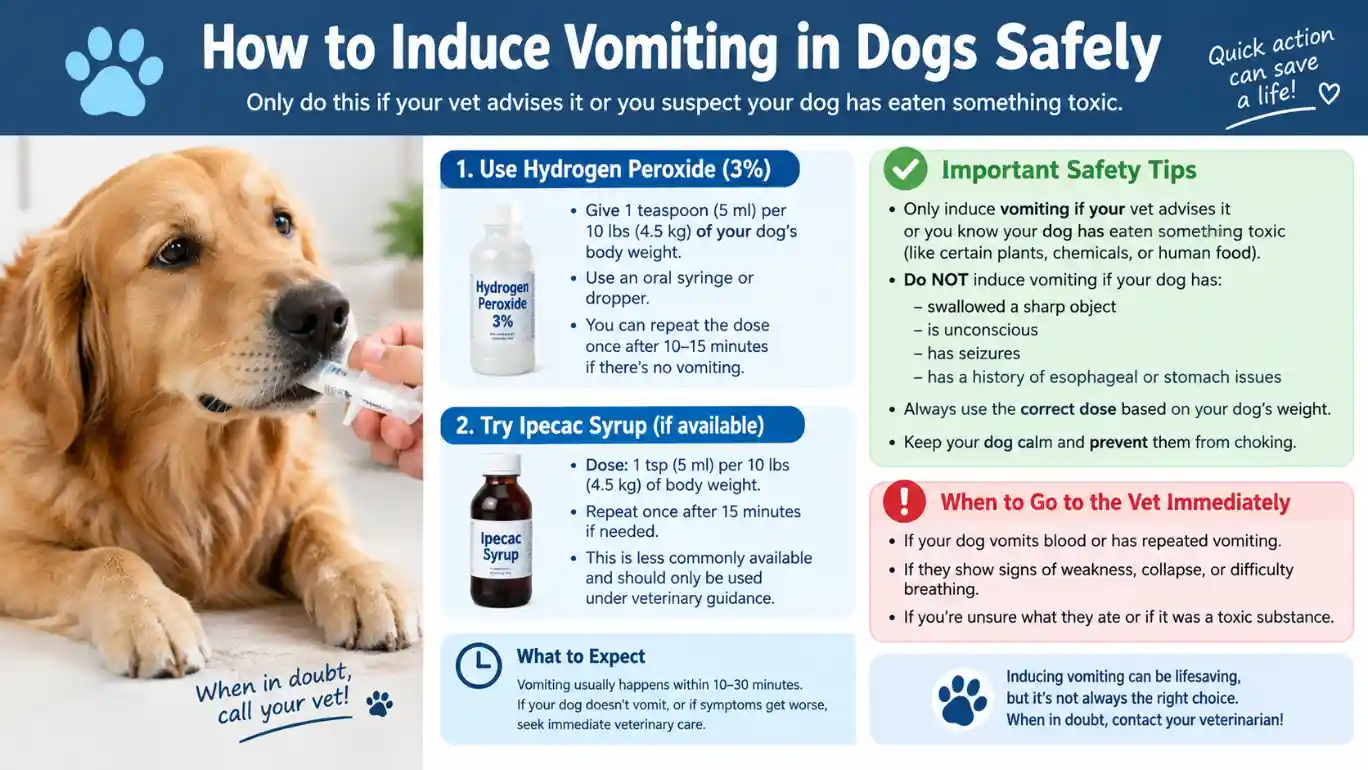
If your dog swallowed something potentially toxic, do not induce vomiting until you speak with a veterinarian or animal poison-control expert. Vomiting can sometimes help remove a recently swallowed toxin, but it can also cause serious injury or aspiration. In the U.S., contact your veterinarian, ASPCA Poison Control at (888) 426-4435, or Pet Poison Helpline at (855) 764-7661 for case-specific instructions.
Key Takeaways
- Never make a dog vomit automatically after it eats something unusual.
- Contact a veterinarian or poison-control service before inducing vomiting.
- Veterinarians may recommend 3% hydrogen peroxide for some dogs and situations, but the appropriate amount depends on the individual case.
- Never use salt, mustard, syrup of ipecac, oil, or other homemade remedies to make a dog vomit.
- Corrosive chemicals, petroleum products, batteries, sharp objects, neurological symptoms, and impaired consciousness can make vomiting dangerous.
Should You Induce Vomiting in a Dog?
If your dog has swallowed something potentially dangerous, your first instinct may be to make the dog throw up. In some poisoning cases, inducing vomiting can reduce the amount of toxin absorbed by the body. However, it is not appropriate for every ingestion.
Veterinary toxicology guidance emphasizes that the decision depends on several factors, including what your dog swallowed, how much was consumed, how long ago it happened, your dog’s current symptoms, and the dog’s overall health.
For this reason, do not automatically reach for a home remedy. Call your veterinarian or an animal poison-control service first. The ASPCA Poison Control Center is available 24/7 at (888) 426-4435, while the Pet Poison Helpline is available at (855) 764-7661.
When Inducing Vomiting May Be Appropriate
A veterinarian may consider inducing vomiting when a dog has recently swallowed a substance that can safely be removed through the stomach.
Timing can be important. Veterinary toxicology guidance notes that emesis is generally more useful when performed relatively soon after ingestion, although the ideal window varies depending on the specific toxin. The ASPCA notes that emesis can be most productive within roughly 30 to 90 minutes for appropriate cases.
Your veterinarian may consider vomiting when:
- The ingestion was recent.
- The substance is known and potentially dangerous.
- The substance is not corrosive or likely to cause additional injury when brought back up.
- Your dog is alert and has a normal swallowing and gag reflex.
- Your dog is not already vomiting.
- Your dog is not showing serious neurological or respiratory symptoms.
Even when vomiting is appropriate, it does not guarantee that all of the substance will be removed. Additional veterinary treatment may still be necessary.
When You Should Never Make a Dog Vomit
Some situations can become significantly worse if vomiting is induced.
Corrosive chemicals
Strong acids and alkalis can burn the mouth, esophagus, and stomach. Bringing these substances back up can expose the tissues to the chemical a second time.
Examples include some drain cleaners, strong cleaning products, oven cleaners, and other caustic substances.
If your dog has swallowed a corrosive product, do not try to make the dog vomit. Contact a veterinarian or poison-control expert immediately.
Petroleum products and hydrocarbons
Gasoline, kerosene, certain oils, and petroleum distillates can be especially dangerous because they may enter the lungs if vomited and aspirated.
Aspiration can lead to serious respiratory complications, including aspiration pneumonia.
Batteries and sharp objects
A battery or sharp object may injure the mouth, esophagus, stomach, or intestines while moving back upward. Batteries can also cause serious tissue damage depending on their type and condition.
If your dog swallowed a battery or sharp object, contact an emergency veterinarian or poison-control service rather than trying to induce vomiting.
Neurological symptoms
Do not attempt to induce vomiting if your dog is having seizures, is unconscious, severely depressed, has difficulty swallowing, or cannot protect its airway.
Vomiting requires a functioning protective airway reflex. If that reflex is impaired, stomach contents can enter the lungs.
Your dog is already vomiting
If your dog is already vomiting, additional attempts to induce vomiting may be unnecessary and could increase the risk of complications.
The same applies when your dog is showing significant symptoms of poisoning. At that point, immediate veterinary assessment is more important than trying a home remedy.
How Veterinarians May Induce Vomiting
Veterinarians have several options for inducing vomiting in dogs. The appropriate choice depends on the situation.
Hydrogen peroxide
A 3% hydrogen peroxide solution is sometimes used to induce vomiting in dogs when a veterinarian or poison-control professional determines that it is appropriate.
Veterinary references describe 3% hydrogen peroxide as an emetic option for dogs, but it can irritate the stomach and may cause complications if used incorrectly.
Because the appropriate amount depends on the dog’s weight, health, ingestion, and circumstances, follow the exact instructions given by your veterinarian or poison-control professional rather than relying on a generic internet dose.
Do not substitute stronger concentrations. Products such as concentrated peroxide or hair-developer products can be dangerous.
Veterinary emetics
Veterinarians can also use medications specifically intended to cause vomiting in dogs. Examples include apomorphine and ropinirole.
These treatments can be administered under professional supervision and may be preferable in situations where a controlled veterinary approach is available.
The goal is not simply to make the dog vomit. The veterinarian first determines if vomiting is actually beneficial and safe.
What You Should Never Give a Dog to Make It Vomit
Internet searches often produce home remedies for inducing vomiting. Many of these are unsafe or unreliable.
Do not use:
- Table salt
- Mustard
- Syrup of ipecac
- Cooking oil or grease
- Dish soap
- Raw eggs
- Baking soda
- Alcohol
- Fingers or objects placed down the throat
Salt is particularly concerning because excessive sodium can cause serious salt toxicity. Veterinary references specifically advise against using salt and syrup of ipecac for inducing vomiting in dogs.
Putting your fingers or another object into your dog’s throat is also dangerous. It may cause injury, trigger biting, or fail to produce useful vomiting.
The safest approach is to contact a veterinary professional before giving your dog anything.
What to Do If Your Dog Ate Something Toxic
If you believe your dog has swallowed a potentially poisonous substance, act calmly but quickly.
1. Remove your dog from the source
Prevent your dog from eating or licking more of the substance. If possible, keep other pets away from the area as well.
2. Identify what was swallowed
Find the product container, medication bottle, food package, plant, or other material involved.
The exact product name and ingredient list can be extremely helpful to a veterinarian or poison-control specialist.
3. Estimate the amount
Try to determine how much your dog may have consumed. You do not need to know the exact amount, but even an estimate can help professionals assess the risk.
4. Note the time
Write down approximately when the ingestion occurred.
Timing can influence if vomiting is useful and what other treatments may be appropriate.
5. Know your dog’s weight
Your dog’s approximate body weight is another important piece of information for veterinary toxicology calculations.
6. Call for professional advice
In the United States, you can contact your veterinarian, an emergency veterinary hospital, or an animal poison-control service.
The ASPCA Poison Control Center can be reached at (888) 426-4435. Pet Poison Helpline can be reached at (855) 764-7661.
Both services can help determine if the specific exposure requires vomiting, monitoring, emergency treatment, or another form of decontamination.
What Happens After a Dog Vomits?
If your veterinarian has instructed you to induce vomiting, continue watching your dog closely.
Vomiting does not necessarily mean the danger has passed. Some toxins are absorbed quickly, while others can continue causing problems after the stomach has been emptied.
Your veterinarian may recommend additional treatment, such as observation, intravenous fluids, medication, activated charcoal in selected cases, laboratory testing, or hospitalization.
Seek immediate veterinary attention if your dog develops difficulty breathing, weakness, seizures, collapse, severe lethargy, repeated vomiting, abnormal behavior, or other concerning symptoms.
If you induced vomiting under professional direction, tell the veterinarian exactly what was given, how much was used, and what happened afterward.
Frequently Asked Questions
Can I use hydrogen peroxide to make my dog vomit?
A veterinarian may recommend 3% hydrogen peroxide in certain dog poisoning cases, but it should not be given automatically. The wrong concentration or amount can cause injury, and some substances should never be brought back up. Contact your veterinarian or poison-control service first.
How quickly should I act if my dog ate poison?
Act immediately. Do not wait for symptoms to appear. Some toxic exposures can produce delayed signs, and early professional guidance can affect treatment options. Gather the product information, estimated amount, ingestion time, and your dog’s weight before calling.
Can salt make a dog vomit?
Salt should not be used to induce vomiting. Excessive salt can cause sodium toxicity and potentially serious neurological complications. Veterinary toxicology sources specifically advise against salt as a home emetic.
Should I induce vomiting if my dog swallowed a battery?
No. Batteries can cause serious tissue injury, and vomiting may expose the esophagus to additional damage. Contact an emergency veterinarian or poison-control service immediately for specific instructions.
What if my dog swallowed gasoline or another petroleum product?
Do not induce vomiting unless a veterinary professional specifically tells you to do so. Petroleum products can be aspirated into the lungs during vomiting and may cause serious respiratory complications.
Does vomiting remove all of the poison?
No. Vomiting may reduce the amount of material remaining in the stomach, but it does not guarantee complete removal. Some substances may already have moved beyond the stomach or been absorbed. Your veterinarian may recommend additional treatment.
Conclusion
The safest answer is not to use a one-size-fits-all home recipe. First determine if vomiting is appropriate for the substance and your dog’s condition.
If your dog has swallowed something potentially toxic, contact your veterinarian or an animal poison-control professional immediately. If they determine that vomiting is appropriate, follow their exact instructions regarding the method and amount.
Most importantly, avoid improvised remedies such as salt, mustard, oil, ipecac, or putting objects into your dog’s throat. In a poisoning emergency, the right treatment depends on the toxin, timing, amount, and condition of the dog.

I am Stephen King an American writer exploring spirituality, dreams, mindfulness, and personal growth. Through SpiritualDreamz.com, he shares thoughtful insights to inspire reflection, clarity, and meaningful everyday living.










