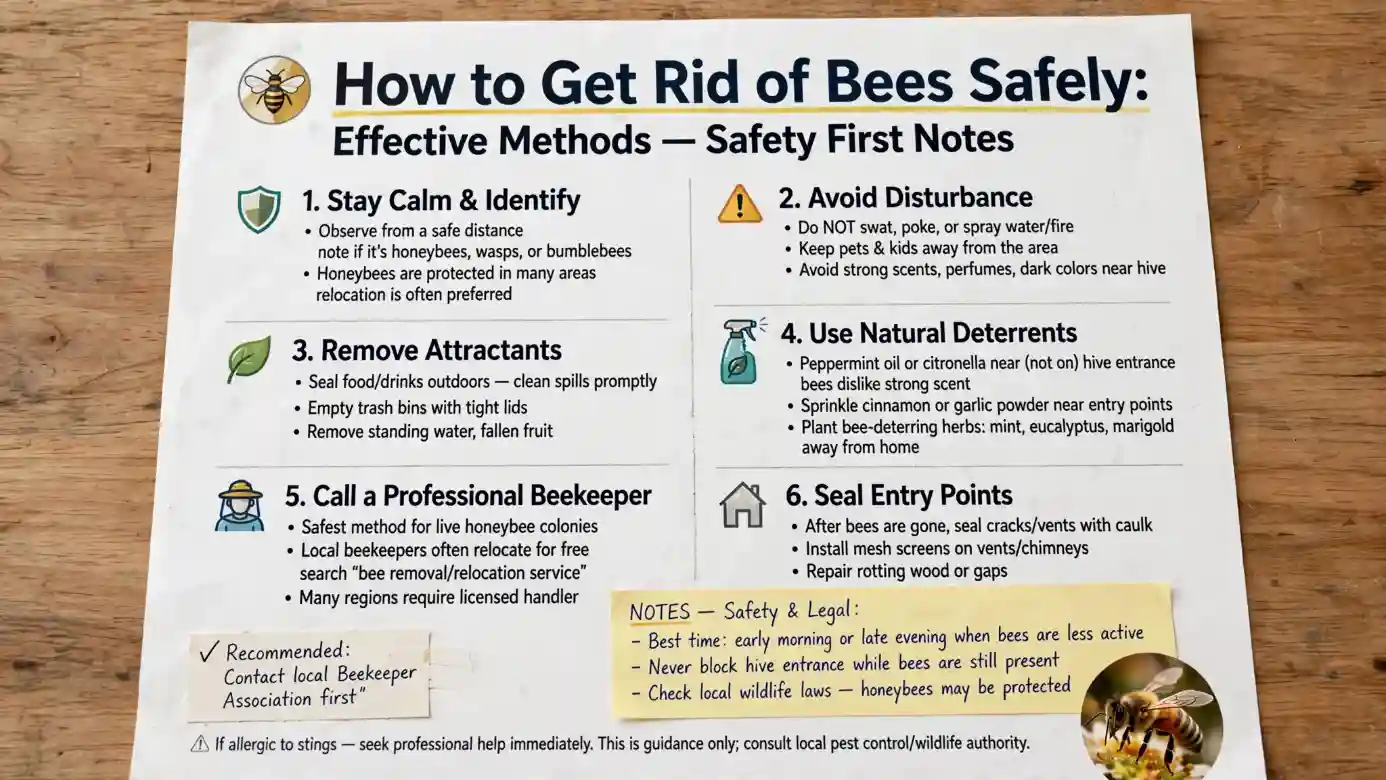
The safest way to get rid of bees depends on the type of bee and where it is nesting. For honey bees, contact a local beekeeper for humane removal whenever possible. For carpenter bees, address exposed wood and active nesting holes. Avoid disturbing large colonies, sealing active nest entrances, or spraying pesticides without first identifying the insect.
Key Takeaways
- Identify the insect before trying to remove it because bees, wasps, and yellow jackets require different approaches.
- Honey-bee swarms are often temporary and may leave on their own.
- An established honey-bee colony inside a wall or structure is best handled by an experienced beekeeper or qualified professional.
- Carpenter bees can be managed by treating active nesting areas and protecting exposed wood.
- Never take unnecessary risks around a large or aggressive colony, especially if anyone nearby has a history of severe insect-sting allergies.
1. Identify the Bee Before Removing It
The first step in learning how to get rid of bees is figuring out what you are actually dealing with.
Not every flying, stinging insect around your home is a bee. Yellow jackets, hornets, and wasps are often mistaken for bees, but their behavior, nesting habits, and control methods can be very different.
Honey bees are usually hairy and have a brownish or golden appearance. Carpenter bees are larger and often have a noticeably shiny abdomen. Bumble bees are generally larger and fuzzier.
If you are unsure, take a photo from a safe distance and have the insect identified by a local extension office, beekeeper, or pest professional.
Honey Bees
Honey bees may form temporary swarms when part of a colony leaves with a queen to establish a new colony. A swarm can contain hundreds or thousands of bees and may cluster on a tree branch, shrub, fence, or other object. These swarms are often temporary and may move on after scouts locate a suitable nesting site.
If the swarm is not creating an immediate danger, keep people and pets away and give it space.
Carpenter Bees
Carpenter bees create tunnels in wood. You may notice perfectly round holes in decks, eaves, fences, siding, or other exposed wooden structures.
Unlike a honey-bee swarm, carpenter bees can repeatedly use wooden structures for nesting. Extension guidance recommends addressing the active nesting areas and protecting exposed wood. Because treatments may involve insecticides and elevated locations, professional help can be appropriate.
Bumble Bees and Ground-Nesting Bees
Some bees nest in or near the ground. If you see bees entering small holes in a lawn, the insects may be ground-nesting bees rather than honey bees.
Many ground-nesting bees are relatively nonaggressive and may only be active for part of the year. Before treating a lawn, determine if removal is actually necessary.
Bees vs. Wasps and Yellow Jackets
This distinction matters.
Wasps and yellow jackets can be more defensive around their nests and may sting repeatedly. If the insects are smooth-bodied, brightly marked, or behaving aggressively around a nest, don’t automatically assume they are bees.
If you are dealing with a large nest of yellow jackets, hornets, or wasps, professional pest control may be safer than attempting DIY removal.
2. How to Get Rid of Bees Safely
The best method depends on the situation.
For a Single Bee
If one bee enters your home, you usually do not need insecticide.
Close doors to other rooms and open a nearby exterior door or window. Turn off unnecessary indoor lights and give the bee an opportunity to leave.
Avoid swatting at it. Remaining calm and giving the insect a clear exit is safer than provoking it. Stinging insects can react defensively when disturbed.
For a Temporary Swarm
If hundreds of honey bees suddenly cluster on a branch, fence, or another outdoor surface, do not spray them.
Keep children and pets away from the area and avoid shaking, hitting, or disturbing the cluster. Contact a local beekeeper or bee-removal service that handles live honey-bee relocation.
University extension guidance notes that experienced beekeepers may collect swarms and relocate them.
For an Established Hive or Colony
A colony inside a wall, attic, chimney, roof, or other building cavity is a different problem.
Do not simply seal the entrance while the colony is still inside. Honey bees may search for another exit and can potentially enter the living space.
Instead, contact an experienced beekeeper or professional who has experience removing colonies from structures.
Removing an established colony can require access to the cavity and removal of honeycomb. Professional removal is often safer and can also reduce the possibility of leaving behind comb and honey that could create future problems.
For Carpenter Bees
Start by locating the active holes in exposed wood.
Carpenter bees use tunnels in wood for nesting. Long-term control can involve treating active nesting sites and protecting the wood afterward. Painting or sealing exposed wood can also make potential nesting sites less attractive.
Because some carpenter-bee treatment involves insecticides, ladders, or areas around rooflines and eaves, consider hiring a licensed pest professional when the nest is difficult to reach.
For Ground-Nesting Bees
First determine if removal is necessary.
If the bees are simply using a small area of lawn temporarily and are not creating a safety problem, leaving them alone may be the simplest solution.
If they are located next to a frequently used walkway, play area, or other high-traffic location, ask a local extension professional or pest-control expert to identify them and recommend an appropriate solution.
3. How to Get Bees Out of Your House
Finding bees inside your home can be alarming, especially if you hear buzzing coming from a wall.
For a single bee, provide an open route outdoors.
For repeated bee activity, look for signs of an established colony, such as:
- Bees repeatedly entering one exterior opening
- Continuous activity around a wall, roof, soffit, or chimney
- Buzzing coming from inside a wall
- Bees appearing indoors repeatedly
- Honey or wax odors or residue
- A large number of bees concentrated around one opening
If you suspect a colony inside the structure, don’t plug the opening immediately.
Instead, contact a beekeeper or professional bee-removal specialist. Removing an established colony from a building can require opening part of the structure and physically removing the bees and comb.
4. What Not to Do When You Find Bees
Some common DIY approaches can make a bee problem more dangerous.
Don’t immediately spray a large colony. Pesticides can kill bees and expose other organisms to unnecessary chemical risk. EPA guidance emphasizes reducing pesticide exposure to pollinators and following product-label requirements.
Don’t hit or disturb a swarm. A cluster of honey bees may look frightening, but swarms are often temporary. Disturbing them can increase defensive behavior.
Don’t seal an active colony inside a wall. Bees may search for another route, potentially causing them to enter the house.
Don’t climb onto a roof or ladder to reach a nest if you lack proper equipment. A sudden wave of flying insects while you’re elevated creates an unnecessary fall and sting risk.
Don’t assume every stinging insect is a honey bee. Correct identification should come before choosing a control method.
5. How to Prevent Bees From Coming Back
Once bees have been removed, prevention is important.
Seal Suitable Nesting Locations
After an established colony has been professionally removed, repair the opening used by the bees. For carpenter bees, protect exposed wood and address existing holes according to the recommended treatment.
Maintain Screens and Openings
Repair damaged window and door screens and check gaps around structures where insects could enter.
Reduce Unnecessary Attractants
Keep outdoor food and sugary drinks covered, use tightly fitting garbage-can lids, and clean up spills promptly. These practices are especially useful for preventing unwanted encounters with yellow jackets and other stinging insects.
Be Careful With Pesticides
If pesticide treatment is genuinely necessary, use only a product registered for the intended use and follow its label exactly. EPA notes that most insecticides can be toxic to bees and recommends practices that reduce exposure to pollinators.
Do not spray flowering plants while bees are actively foraging.
6. When to Call a Professional
Professional help is the better choice when:
- You have a large colony.
- Bees are inside a wall, attic, chimney, or roof.
- You cannot identify the insect.
- The nest is high or difficult to reach.
- Bees become unusually defensive.
- Someone nearby has a serious insect-sting allergy.
- You would prefer live honey-bee removal.
- DIY treatment would require climbing or using pesticides.
For honey-bee colonies, specifically ask if the provider performs live bee removal and relocation rather than automatically exterminating the colony.
University of California IPM recommends professional help for established honey-bee colonies in structures, while extension services commonly recommend contacting experienced beekeepers for swarms.
7. What to Do After a Bee Sting
If you are stung, move away from the area so you do not receive additional stings.
For a typical localized reaction, wash the area with soap and water, remove a honey-bee stinger by scraping rather than squeezing it, and apply ice to reduce swelling.
A serious allergic reaction requires immediate medical attention.
Warning signs can include:
- Hives or swelling away from the sting
- Difficulty breathing
- Wheezing
- Swelling of the tongue or throat
- Difficulty swallowing
- Dizziness or fainting
- Severe vomiting or abdominal symptoms
Anaphylaxis can develop rapidly and can be life-threatening. If someone has a prescribed epinephrine auto-injector and develops symptoms of anaphylaxis, it should be used according to their emergency plan, followed by immediate emergency medical care.
Frequently Asked Questions
What is the fastest way to get rid of bees?
The fastest safe solution depends on the species. For a single bee indoors, provide an exit. For a honey-bee swarm, keep your distance and contact a beekeeper. For an established colony or difficult nest, professional removal is usually the safest option.
How do I get rid of bees without killing them?
For honey bees, contact a beekeeper or bee-removal specialist who offers live colony or swarm relocation. Do not disturb or spray the colony yourself. Established colonies inside structures can require specialized removal techniques.
Will bees leave on their own?
A temporary honey-bee swarm often will. Swarms may remain clustered while scout bees search for a new nesting location, after which the group may leave. An established colony inside a wall or structure is different and generally should not be expected to leave simply because you wait.
How do I get rid of carpenter bees?
Locate the active nesting holes and address the exposed wood. Carpenter-bee management may involve treating active tunnels and protecting wood afterward. If the holes are high, numerous, or difficult to reach, contact a pest professional.
Should I call a beekeeper or an exterminator?
For honey bees, a beekeeper or live-bee-removal specialist is often the best first choice if relocation is possible. For carpenter bees, wasps, yellow jackets, or difficult pest situations, a qualified pest professional may be more appropriate.
Can I seal a bee nest entrance?
Not while an active colony is still inside. Sealing the entrance can cause bees to search for another route and may drive them into the building. Have an active colony removed first, then repair the opening.
What keeps bees away from my house?
The best long-term approach is to address attractive nesting locations, repair structural openings, protect exposed wood where carpenter bees are nesting, and avoid unnecessary pesticide use. For a recurring colony, professional inspection can identify the underlying nesting site.
Conclusion
Learning how to get rid of bees starts with identifying the type of bee and understanding where it is nesting. A single bee or temporary honey-bee swarm may not require aggressive action, while an established colony inside a wall, attic, or roof should usually be handled by an experienced beekeeper or qualified professional.
Avoid disturbing large colonies or sealing active nest entrances before removal. For long-term prevention, repair openings, protect exposed wood, and keep your property well maintained. When safety is a concern or you are unsure what type of insect you are dealing with professional help is the safest choice

I am James Patterson an American writer sharing thoughtful insights on dreams, spirituality, personal growth, and everyday life through practical guides and meaningful stories for SpiritualDreamz.com readers everywhere with warmth.










