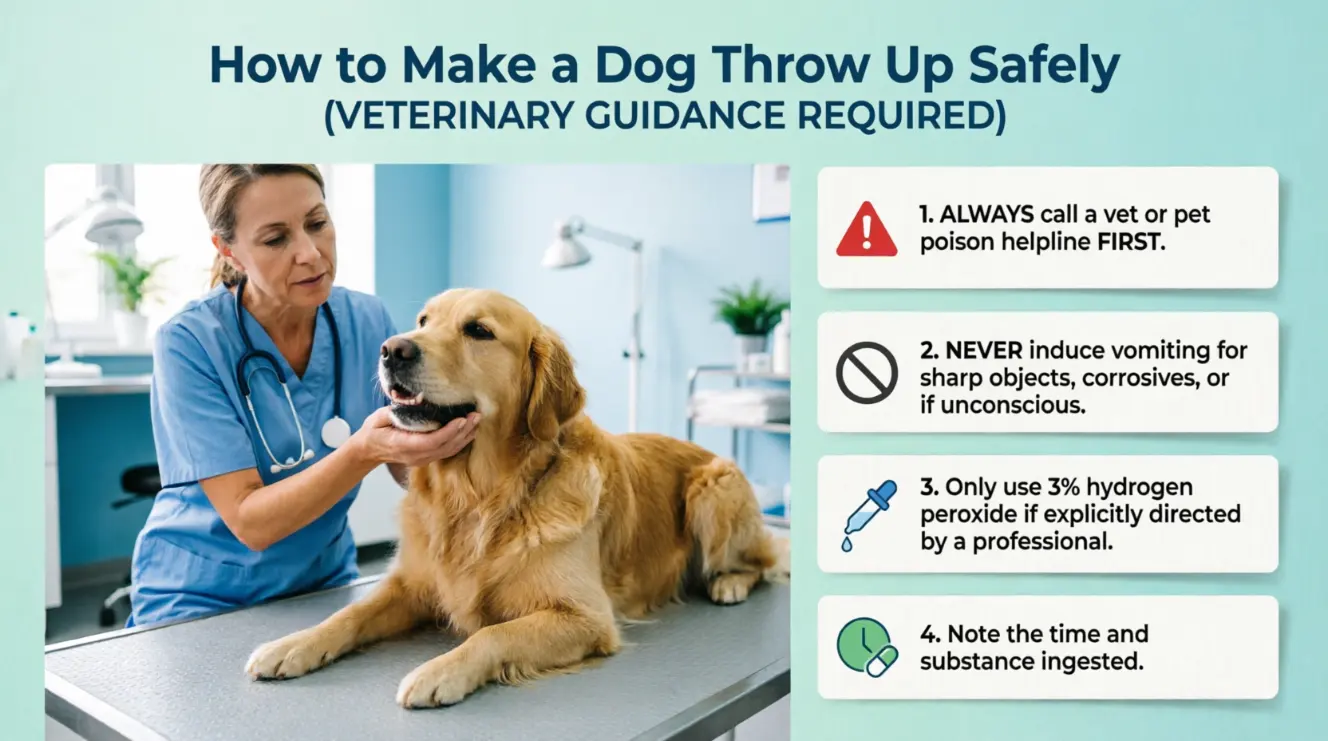
If your dog eats something potentially poisonous, contact your veterinarian or an animal poison control center before trying to make them throw up. A veterinarian may recommend inducing vomiting in certain cases, but it can be dangerous depending on what your dog swallowed and their condition. Never use home remedies or hydrogen peroxide without professional instructions.
Key Takeaways
- Never make your dog vomit without first consulting a veterinarian.
- Hydrogen peroxide may be used in certain cases, but it can also cause serious harm.
- Some substances, including household cleaners and petroleum products, can cause additional injuries when vomited.
- Contact a veterinarian or animal poison control immediately if your dog swallows something potentially toxic.
- If your dog is unconscious, having seizures, or struggling to breathe, seek emergency veterinary care immediately.
Should You Make Your Dog Throw Up?
If your dog accidentally eats something dangerous, making them vomit might seem like the quickest way to protect them. However, vomiting is not always the right treatment.
Veterinarians sometimes induce vomiting to remove harmful substances from a dog’s stomach before the body absorbs them. This procedure is called induced emesis.
It may be appropriate when a dog has recently swallowed certain toxic substances and is still alert and able to swallow normally. However, the decision depends on the substance, the amount swallowed, the time since ingestion, and the dog’s health.
For example, a dog that eats certain medications may need immediate treatment. Another dog that swallows a corrosive cleaning product could suffer additional injuries if forced to vomit.
Therefore, the first step is always to contact a veterinarian, rather than attempting to make your dog throw up yourself.
What to Do If Your Dog Eats Something Toxic
If you suspect your dog has swallowed something harmful, take the following steps.
1. Remove the Substance
Move your dog away from the substance to prevent further exposure. If your dog is eating medication, food, chemicals, or another potentially dangerous product, remove anything that remains within reach.
Do not try to force your dog to eat or drink anything. Avoid giving medication or home remedies unless a veterinary professional recommends them.
2. Identify What Your Dog Ate
Try to identify the substance your dog swallowed. Check the product’s packaging, ingredient list, or label.
If possible, determine:
- What your dog swallowed
- Approximately how much they consumed
- When the incident happened
- Whether your dog is showing any unusual symptoms
This information helps the veterinarian assess the potential danger and recommend appropriate treatment.
3. Call Your Veterinarian
Contact your veterinarian or an emergency animal hospital immediately. You can also contact a US animal poison control center.
US Animal Poison Control Numbers
ASPCA Animal Poison Control
888-426-4435
Available 24 hours a day, every day. A consultation fee may apply.
Official ASPCA Poison Control
Pet Poison Helpline
855-764-7661
24-hour animal poison assistance. A consultation fee may apply.
Official Pet Poison Helpline
These services can help determine whether your dog needs emergency treatment and whether vomiting is appropriate.
4. Follow Professional Instructions
Your veterinarian will decide whether inducing vomiting is appropriate. Depending on the situation, they may recommend bringing your dog to a clinic for treatment.
Veterinarians have medications and equipment that can induce vomiting while allowing them to monitor your dog’s condition.
If your veterinarian recommends an at-home approach, follow their exact instructions. Do not repeat a treatment or increase the amount if your dog does not vomit.
Can You Make a Dog Vomit at Home?
Sometimes, but only when a veterinarian specifically recommends it.
Veterinarians may use 3% hydrogen peroxide in selected cases to induce vomiting in dogs when appropriate veterinary treatment is not immediately available. However, it is not safe for every dog or every poisoning incident.
Hydrogen peroxide irritates the stomach lining to trigger vomiting. Incorrect use can cause severe stomach irritation, ulcers, or other complications. It can also lead to aspiration, which occurs when vomit enters the lungs.
Why Hydrogen Peroxide Requires Veterinary Guidance
Before recommending hydrogen peroxide, a veterinarian needs to consider your dog’s size, health, symptoms, and the substance they swallowed.
Some dogs need a different treatment entirely. Others may already have absorbed the dangerous substance, making vomiting ineffective or unnecessary.
Never use concentrated hydrogen peroxide or give it repeatedly without professional instructions.
When Should You Never Make Your Dog Throw Up?
Inducing vomiting can be dangerous in several situations. Do not attempt it if your dog:
- Swallowed a corrosive substance: Drain cleaners, strong acids, and certain household chemicals can burn the throat and esophagus again when vomited.
- Swallowed petroleum products: Gasoline, kerosene, and similar substances can enter the lungs during vomiting and cause serious respiratory problems.
- Swallowed a sharp object: Sharp bones or other objects may injure the throat or esophagus on the way back up.
- Is unconscious or having seizures: Your dog may inhale vomit because they cannot protect their airway.
- Is having difficulty breathing or swallowing: Vomiting may increase the risk of choking or aspiration.
- Is already vomiting repeatedly: Additional vomiting may not help and can worsen dehydration or other complications.
Dogs with certain medical conditions or a high risk of aspiration may also need alternative treatment.
If any of these situations apply, seek veterinary advice immediately instead of attempting to induce vomiting.
What Home Remedies Should You Avoid?
Many home remedies advertised online are ineffective or potentially harmful. Do not use them to make your dog vomit.
| Home remedy | Why you should avoid it |
| Salt | Can cause dangerous sodium poisoning. |
| Mustard | Is unreliable and may irritate the digestive system. |
| Dish soap | Can cause irritation and other complications. |
| Raw eggs | Do not reliably induce vomiting. |
| Cooking oil | Can cause digestive problems and aspiration. |
| Fingers down the throat | Can injure your dog and may result in a bite. |
Even if a remedy appears harmless, it may delay proper treatment or make the situation worse. Contact a veterinarian before giving your dog anything to induce vomiting.
Signs Your Dog Needs Emergency Veterinary Care
Some symptoms of poisoning appear immediately, while others may take hours or longer to develop. Do not wait for symptoms before seeking advice if you know your dog has swallowed something toxic.
Watch for these warning signs:
- Repeated vomiting or retching
- Excessive drooling
- Weakness or unusual tiredness
- Difficulty walking or loss of coordination
- Tremors or seizures
- Difficulty breathing
- Blood in vomit or stool
- Collapse or loss of consciousness
If your dog has difficulty breathing, collapses, or experiences seizures, go to an emergency veterinary hospital immediately.
Repeated attempts to vomit without producing anything, especially with a swollen abdomen, can also indicate a life-threatening condition called gastric dilatation-volvulus (bloat). Do not attempt to induce vomiting in this situation.
Frequently Asked Questions
How can I make my dog throw up at home?
First, call your veterinarian or an animal poison control center. They will determine whether vomiting is necessary and whether it can be done safely at home. A veterinarian may recommend 3% hydrogen peroxide in certain circumstances, but never administer it without professional guidance.
Is hydrogen peroxide safe for dogs?
Hydrogen peroxide is not completely safe for dogs. Although veterinarians sometimes recommend a 3% solution to induce vomiting, it can irritate the stomach and cause complications. The wrong amount or inappropriate use may lead to serious injury. Only use it if a veterinarian specifically instructs you to do so.
How long after eating something toxic can a dog vomit?
The timing depends on the substance, the amount eaten, and how quickly it leaves the stomach. Inducing vomiting may help in some cases when performed soon after ingestion, but there is no universal time limit. Contact a veterinarian immediately, even if several hours have passed.
What if my dog has already vomited?
If your dog has already vomited after eating something potentially toxic, do not try to make them vomit again. Contact your veterinarian and explain what happened. Vomiting does not necessarily mean that the dangerous substance has been completely removed. Your dog may still need treatment or monitoring.
Can I make my dog vomit without hydrogen peroxide?
There is no reliable, universally safe home remedy for making a dog vomit. Veterinarians may use prescription medications to induce vomiting in a clinical setting. Avoid salt, mustard, dish soap, and other internet remedies. Contact your veterinarian to determine the safest option for your dog.
Conclusion
Knowing how to make a dog throw up is important when dealing with accidental poisoning, but inducing vomiting is not always the safest solution. The correct treatment depends on what your dog swallowed, how much they consumed, and their current health.
If your dog eats something potentially dangerous, contact a veterinarian or animal poison control center immediately. Never use hydrogen peroxide or home remedies without professional instructions. Quick, appropriate veterinary care can help protect your dog from serious complications.

I am Toni Morrison an acclaimed American novelist and Nobel Prize winner whose powerful storytelling explored identity, memory, love, heritage, and the human spirit through unforgettable literary works at Spiritualdreamz.com.










