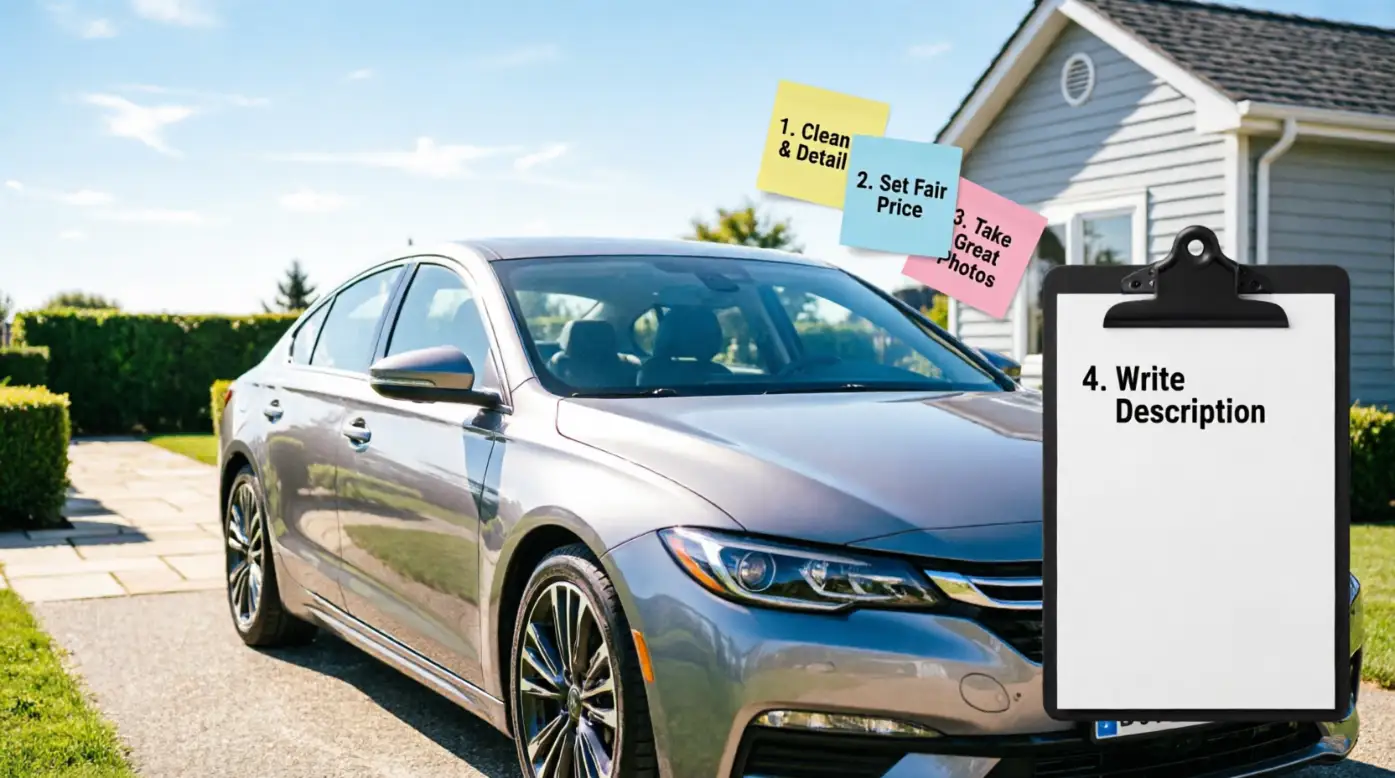
To sell a car in the U.S., determine its market value, gather the required documents, prepare the vehicle, create an accurate listing, screen buyers, negotiate the price, verify payment, and complete the title and DMV paperwork. A private sale can bring more money, while a dealer or online offer is usually faster and easier. State requirements vary, so check your state’s DMV before completing the transaction.
Key Takeaways
- Compare private-party, dealer, and online cash offers before choosing how to sell.
- Use your car’s condition, mileage, trim, features, and local listings to set a realistic price.
- Have the title, maintenance records, and other required documents ready.
- Never hand over the car until payment has been properly verified.
- Complete your state’s title-transfer and seller-notification requirements after the sale.
1. Choose How You Want to Sell Your Car
Before preparing your car, decide which selling method fits your priorities.
Private sale: Selling directly to another person can potentially bring you more money, but you must handle advertising, buyer questions, test drives, negotiation, payment, and paperwork yourself. Current automotive guides generally describe private selling as the higher-effort option with the potential for a higher return.
Dealer trade-in: Trading the vehicle toward another car is convenient because the dealership handles much of the transaction. The trade-off is that your offer may be lower than what you could achieve through a successful private sale.
Online cash offer: Online buying services can provide a faster, more convenient way to sell. For example, some services let you enter your VIN or license plate, receive an offer, and bring the vehicle in for inspection and payment.
If maximizing your selling price matters most, start by researching a private-party price and get one or two dealer or online offers as a comparison.
2. Gather Your Documents
Paperwork is one of the most important parts of selling a car. Before you advertise it, find your vehicle title and check that the ownership information is correct.
Depending on your state and situation, you may need:
- Vehicle title
- Current registration
- Bill of sale
- Odometer disclosure
- Maintenance and repair records
- Lien-release documentation
- Emissions or safety inspection documents, if required
- Release-of-liability or seller-notification paperwork
Requirements differ from state to state, so don’t assume another state’s procedure applies to you. Edmunds specifically recommends checking your state’s DMV for title-transfer and release-of-liability requirements.
If you still owe money on the car, contact your lender before listing it. The lender may hold the title, and the sale may need to be completed through the lender or another approved process.
3. Find Out What Your Car Is Worth
Pricing your car correctly can make the difference between getting serious buyers and having your listing sit for weeks.
Start with reputable valuation tools such as Kelley Blue Book, Edmunds, or J.D. Power. Enter the exact year, make, model, trim, mileage, options, location, and condition. Then check comparable vehicles currently advertised in your local market.
Don’t confuse trade-in value with private-party value. A dealer’s offer accounts for the dealer’s costs and potential resale margin, while a private buyer is comparing your car directly with other vehicles for sale.
A practical approach is to set three numbers:
- Target price — what you hope to receive.
- Asking price — the amount you advertise.
- Minimum price — the lowest amount you will accept.
Leave yourself reasonable negotiating room, but avoid pricing dramatically above comparable cars. Buyers can easily compare listings online.
4. Prepare the Car for Sale
You don’t necessarily need to spend thousands on repairs before selling. Focus on improvements that make the vehicle look cared for and remove obvious problems.
Start by:
- Washing and vacuuming the car.
- Cleaning the windows and wheels.
- Removing personal belongings.
- Replacing inexpensive burned-out bulbs.
- Checking tire pressure.
- Cleaning stains and odors where practical.
- Completing worthwhile routine maintenance.
Gather service records, receipts, warranty information, and spare keys if you have them. These can help demonstrate that you’ve maintained the vehicle.
Be honest about significant mechanical problems, accident history, warning lights, or cosmetic damage. A transparent listing attracts better buyers and reduces unpleasant surprises during negotiations.
5. Create a Strong Car Listing
Good photos and an accurate description can make your car stand out.
Take clear photos in daylight and show the vehicle from multiple angles. Include:
- Front, rear, and side views
- Interior
- Dashboard and odometer
- Tires and wheels
- Engine compartment
- Trunk or cargo area
- Any scratches, dents, or damage
Your description should include the year, make, model, trim, mileage, major features, maintenance history, ownership information when relevant, and known issues.
Don’t hide flaws. Showing damage in the listing may reduce the number of inquiries, but it can also save you from wasting time with buyers who would reject the car after seeing it.
6. Screen Buyers and Schedule Test Drives
Not every person who contacts you is a serious buyer.
Be cautious if someone:
- I want to buy the car without seeing it.
- Offers significantly more than your asking price.
- Says a shipping company will pick it up.
- Sends unusual payment instructions.
- I want you to pay a fee before the sale.
- Send a check for more than the agreed price.
The Federal Trade Commission warns specifically about fake-check scams targeting online vehicle sellers. A scammer may send a check for more than the selling price and ask you to return the difference. Even if funds initially appear in your account, the check can later be identified as fraudulent.
For test drives, meet in a safe public location and consider having another person with you. Don’t give a stranger unrestricted control of the vehicle.
7. Negotiate the Price
Know your minimum price before meeting a buyer.
A buyer may point out worn tires, cosmetic damage, high mileage, or needed maintenance to negotiate. Listen to legitimate concerns, but don’t feel pressured to accept an unreasonable offer.
Instead of immediately lowering your price, explain the value of the car using its maintenance history, condition, features, and comparable local listings.
For example, if your asking price is $16,500 and the buyer offers $14,000, you might respond with:
“I’ve priced it based on comparable vehicles with similar mileage and condition. I could come down somewhat, but I wouldn’t be able to accept $14,000.”
Keep negotiations focused on the vehicle and the final selling price. Don’t let a buyer’s urgency push you into skipping important paperwork or payment verification.
8. Complete the Sale Safely
Once you and the buyer agree on a price, slow down and complete the transaction carefully.
For a large transaction, meeting at a bank can be useful. It gives both parties a safer place to verify payment and, when necessary, deal with an outstanding auto loan.
Accept payment only when you are confident it is legitimate. Cash can be straightforward for an in-person transaction, while a cashier’s check may require verification with the issuing bank. Edmunds lists cash and verified cashier’s checks among common payment methods for private sales.
Never accept a check for more than the agreed selling price and refund the difference. The FTC identifies this as a common fake-check scam.
After payment is verified, complete the title transfer and any required bill of sale or odometer documentation. Make copies or keep records of the signed documents.
9. Finish the DMV and Insurance Steps
The sale isn’t completely finished when the buyer drives away.
Your state may require you to:
- Submit a release of liability or seller notification.
- Report the sale to the DMV.
- Remove or surrender license plates.
- Keep a copy of the transaction documents.
- Cancel or update the vehicle’s insurance.
- Follow specific title-transfer procedures.
These requirements vary by state. For example, DMV procedures can differ substantially regarding registration, title transfer, plates, and seller notifications.
Check your state’s official DMV website before the transaction and complete the required seller steps promptly.
Also remove personal information from documents you give the buyer. Kelley Blue Book recommends protecting sensitive information in service records and other paperwork.
10. Avoid Common Car-Selling Mistakes
A smooth car sale is mostly about preparation.
Avoid these common mistakes:
Pricing without research: A price based only on what you paid years ago may not reflect today’s market.
Hiding problems: Undisclosed issues can create disputes and destroy buyer trust.
Skipping paperwork: A signed title alone may not satisfy all requirements in your state.
Handing over the car before payment is verified: Never rely solely on a screenshot, payment notification, or a buyer’s promise.
Accepting an overpayment: If someone sends more money than agreed and asks you to return part of it, stop the transaction. The FTC warns that these checks may be fraudulent.
Ignoring a loan: If there’s an outstanding lien, work with the lender before promising immediate title transfer.
Canceling insurance too early: Follow your insurer’s guidance and make sure your coverage situation is appropriate for the vehicle and transaction.
Private Sale vs. Dealer vs. Online Offer
| Selling Method | Potential Price | Convenience | Your Work |
| Private sale | Usually the strongest opportunity to maximize price | Lower | High |
| Dealer trade-in | Often lower than private-party price | High | Low |
| Online cash offer | Varies by company and vehicle | High | Low to moderate |
The best option depends on if your priority is maximum money, speed, or convenience. Private selling can produce a stronger return but requires more effort, while dealer and online options can simplify the process.
Frequently Asked Questions
What is the best way to sell a car?
If your main goal is getting the highest possible price, a private-party sale is usually the first option worth investigating. If speed and convenience matter more, compare dealer trade-in and online cash offers. Get several estimates before deciding.
How much should I ask for my car?
Research its private-party value using reputable valuation tools and compare similar vehicles in your local market. Consider mileage, trim, condition, features, maintenance history, and demand. Set an asking price that leaves some room for negotiation without becoming uncompetitive.
Can I sell a car that still has a loan?
Yes. You can generally sell a financed car, but the lender’s lien must be addressed before ownership can be transferred properly. Contact the lender first and ask exactly how the payoff and title-release process works.
What paperwork do I need to sell a car?
Common documents include the vehicle title, bill of sale, odometer information, maintenance records, and release-of-liability or seller-notification paperwork. The exact requirements depend on your state, so verify them with your DMV before the sale.
Is cash or a cashier’s check safer?
For an in-person transaction, cash can be straightforward, while a cashier’s check should be independently verified with the issuing bank before you release the vehicle. Never accept an overpayment and send money back to a buyer. The FTC warns that fake checks can appear legitimate before a bank later determines they are fraudulent.
What should I do immediately after selling my car?
Keep copies of the signed transaction documents, complete any required DMV seller notification or release of liability, follow your state’s license-plate rules, and update your insurance. Don’t assume the buyer’s registration automatically removes every responsibility from your name.
Final Thoughts
Learning how to sell a car doesn’t have to be complicated. The safest approach is to research the vehicle’s value, prepare it properly, advertise honestly, screen buyers, verify payment, and complete every required title and DMV step.
If maximizing your return is the priority, start by researching the private-party market and comparing it with dealer or online cash offers. If convenience matters more, a quick cash offer or trade-in may be worth accepting even if the potential price is lower.
Most importantly, don’t rush the final transaction. Proper paperwork and verified payment are just as important as getting a good price.

I am Stephen King an American writer exploring spirituality, dreams, mindfulness, and personal growth. Through SpiritualDreamz.com, he shares thoughtful insights to inspire reflection, clarity, and meaningful everyday living.










